6x4 & 6x6 Land Rovers
Leaf Sprung Machines
The Sandringham Six
The Hotspur Sandringham Six was a special vehicle approved by Land Rover. Series III and Stage 1 vehicles were used in the manufacture of these 6x6s, therefore these are leaf sprung 6x6s. Vehicles are advertised in 125" and 139" wheelbases. A sales brochure can be viewed here.
Hotspur Series III 125" Sandringham Six
Denty from the LRUK forum posted these pictures of his machine.
His vehicle has ID plates from Hotspur Cars, and is the Series III 125" version.
The underside picture shows standard Hotspur leaf configuration: one axle set with 109" mounts, one axle set with 88" mounts, staggered to give roughly 36" between second and third axle
centres.

Truck style rear leaf configuration
I found someone had posted pictures of their Sandringham Six-type vehicle on the net, giving some information on the spring setup. It differs from the Hotspur vehicles, but the manufacturer is unknown at present. Any information on this appreciated.

Alternative spring layout
This vehicle has 109" chassis spring mounts on both axles, unlike the Hotspur vehicles. This allows the tougher Salisbury axles to be used on both rear axles without modification. The vehicle was built by Thomas Schnell, and you can see more on this here.

SMC Engineering's Sandringham Six.
SMC Engineering (Bristol) Ltd, (SMC stands for Sandringham Motor Company) designed and built six-wheel drive Land Rovers (Sandringham 6), Range Rovers (Sahara 6), and Forward Controls (FC-82). Here are a couple of pictures of their Stage 1 based 6x6.

This vehicle is in Germany and is progressing through a high quality rebuild.
Neil's vehicle
Neil Anderson's machine was featured in Roverphile in the 7/05 edition of Land Rover Enthusiast.
I got in touch, and now we've got some pics!
His vehicle is a Hotspur Cars Sandringham 6E-139.
The VIN plate shows the Hotspur and Land Rover VINs on the same plate.
This machine is based around the Stage 1 V8.
Spring setup is similar to Denty's vehicle.
Click here or on a picture for more information.
6x6 101 Forward Control

Although this was not a factory-built 6x6 it still has a certain appeal. More on this interesting 6x6 101 FC can be found on the 6x6 101 page. Since these pictures were taken, this vehicle has been fitted with an exterior rollcage and has been repainted in various colours (all at the same time). It has been offered for sale via ebay several times in the last few years.
Safir 6x6s.

Nick very kindly helped out with a little info on A1 LRO (above).
This was a Safir Conversion.
He added: 'We just got a Safir 6wd about a year ago (on eBay, from UK) & shipped it down here to the Falklands; ours is no. 027, & was
reg.d A75 AJM. It was one of 15 converted to cherrypickers, but has since been given a standard body & hardtop job.'

Coil Sprung Machines.
Coil sprung Discoverys, Range Rovers, and Defenders have all been converted to 6x4 or 6x6. Here's some we've found.
Range Rovers

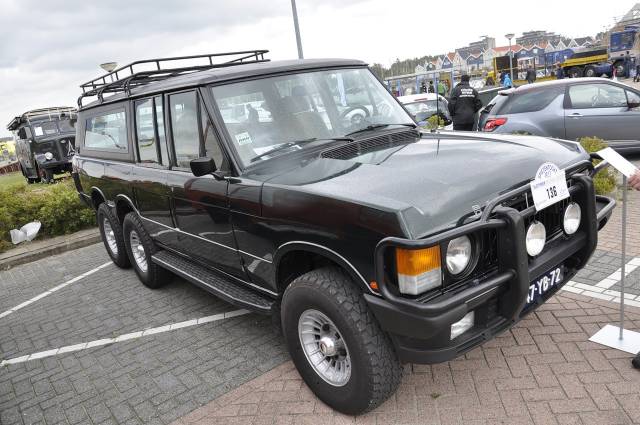
The left-hand picture shows a P38 Range Rover 6x6. This vehicle was available as a specialist vehicle from Jankel Group.
There's also an open top 'hunting' version. (Right-hand picture)

The picture above left shows a Carmichael TACR 2a Rapid Intervention Vehicle - above right shows the very first Range Rover Commando Conversion.
'Commando' is the generic name for six wheel chassis vehicles based on the original Range Rover. Land Rover built the Range Rover Commando cab / chassis, and Land Rover approved companies fitted out these vehicles to their intended use. Amongst these companies were HCB Angus, Gloster Saro and Carmichael. The Gloster Saro chassis had extra strengtheners welded on certain points of the chassis. The chassis were built by Land Rover until the late 1980's, though other companies also built 6x6 Range Rover chassis and vehicles.
Commando:
This is the original 6x4 vehicle based on the early two door model. Some of these vehicles were used by Fire services as Rescue Tenders. Most were produced for Airport fire services as RIVs (Rapid Intervention Vehicles) and fitted with roof mounted foam nozzles. Many are still in use today.
TACR 2
The early TACR 2 was a two door conversion configured as a four door for the Ministry of Defence for RIV duties on it's many airfield sites in both the UK and abroad. The requirement for a four door version to carry more crew meant that builders such as HCB Angus and Gloster Saro had to completely fabricate a four door vehicle. This was done by shortening the front doors and making up the rear doors from scratch. These vehicles can be recognised by the large vertical door handle to the rear of the front door edge and the chrome handle on the top edge of the rear door. Also the door windows are of the non-standard type as they slide in two parts rather than wind down as normal. The engine was the standard 3.5 litre Rover V8 fitted with twin carbs.
TACR2a
When the official four door version arrived a further order was placed by the Ministry of Defence to be built by Carmichael.
These later versions had some differences, notably:
The 3.5 litre Rover fuel injected engine, tubular type crash bar (fitted to the last batch of 80 or so), blue repeater lamps fitted in the grille and longer hose retaining flaps on each
side.
The picture above left shows a 6x6 Range Rover - above right shows a Carmichael Commando Range Rover Conversion.
The bottom left picture shows the very last Scottorn 6x6 Range Rover - more on that here.
(Picture © David Webber - www.barnhill4x4.com)
Bottom right shows another 6x6 conversion.
To view these pictures and many more, visit the SAW group.
Discovery
Whilst not strictly entirely a Discovery, this vehicle is very interesting nonetheless. An ex-Carmichael Commando RIV, it now has now a Discovery body, completed late 2006. It has a 1994 body and interior (with 2002 front and rear end!), 1994 R380 5-speed manual gearbox with 1994 3.9-litre V8 running on LPG, giving 9-11 mpg. The chassis suspension, brakes and axles are all 1978 Range Rover still, hence it keeps it original reg. number. The owner, Trevor Alder, has published a book (titled "The Merzouga Discovery") about the conversion and his trip to the Sahara.

Defenders
(Top left)The Hotspur Hussar 6x6 Armoured Police Vehicle, Built by Penman Specialist Vehicles.
(Top right) Foley Specialist Vehicles have converted this Defender to 6x6 and equipped it for expedition use.
(Bottom) Michael Calvert's 6x6 pick-up is a Land Rover Specialist Vehicles machine.

This specially made 6x6 camper has been widened too.
6x6 Land Rover Pickup
This 1984 3.5 v8 6x6 Land Rover pick-up was sold a while back with only 29,000 miles on the clock.

And here it is now, ready to go to North America.

Pic by Duncan Goodchild - www.landroverimport.com
Reynolds Boughton Defender 6x4 Pickup
Owner Seb Callander wrote:
Here are some photos of my 6x4. The History of the vehicle is a little vague but I am currently trying to find out exactly.
Basically it was a G reg 110 with a 3.5 litre v8 . I dont know if it went straight from the factory to a company called Reynolds
Boughton and was then converted to 6x6 or if it was run as a 110 for a while. I have been in touch with them and they are looking in to it for me.
They dont do conversions any more as far as I know. I have had the landrover for three years and have spent far to much money.
Basically i have rebuilt it from scratch, It now has a 200tdi and new everything apart from the chassis.


6wd Defender
Phil Martin wrote:
I thought I would send you a pic of my 6x6 Defender, taken in Morocco in september 2008. It was built on a Designa chassis and features a 4.6 v8 engine(Petrol is cheap in Guernsey)! Foley 6x6 conversion, ARB locking diffs on all axles, Ashcroft underdrive, QT suspension, including rose jointed A balls, rose jointed radius arms, X eng Springs, and a long list of other items, including 2 alternators, electric fans, and communication gear for its role as a support unit for recovery and volunteer services here in the Channel Islands.
I am going to change the body style to full expedition over the winter (2009-2010) so it will be completely different for next year's Billing show. It weighs 3.2 tonnes all up, and will do well over the speed limit in the UK, let alone our 35mph one in Guernsey!!


Australian Perentie 6x6 LRPV.

The LRPV was introduced into service with the Australian Army in November 1991. This vehicle is used to carry out medium and long range reconnaissance patrols over continental Australia by the Special Air Services Regiment (SASR). With a crew of three, plus stores and equipment the vehicle weighs 4840 kg. It has fuel tank capacity of 365 litres which makes them capable of driving 1600 kms in desert conditions without refuelling, and a maximum speed of 95kmph (around 59mph). This vehicle has an integrated cab and body structure with stowing facilities for equipment and rations as well as a low profile over the crew area. The cab has two seats, no doors and a removable windscreen. Mountings are provided for two machine guns (MAG 58 and MINIMI) and a 250cc Suzuki motorcycle which can be carried across the rear of the body. The Australian army has 27 of these vehicles in service.
Other Perenties.

The LRPV is only one of a range of six wheel drive Land Rover variants procured by the Australian Army via its Perentie programme, the others being an ambulance (pictured above), a general maintenance (workshop) vehicle, an electronic repair vehicle, an air defence variant and a general cargo vehicle. The Perentie Land Rover project, named after a lizard known for it's camouflage and his ability to survive in harshest conditions was developed by Jaguar Rover of Australia (JRA). JRA commenced the design studies in 1981, and in June 1982 were awarded the first design / production contract under the project. Land Rover brought one 6x6 vehicle over to Solihull for evaluation & testing purposes. The first production vehicle entered service on the February 6, 1987, the last on January 21, 1992. Around 700 Perentie 6x6's are in regular service together with 3005 Perentie 4x4 110's, which replaced the Toyota Land Cruiser, Land Rover Series IIa and Land Rover Series III fleets.
All 6x6 Perenties have disc brakes all around and Adwest power steering. About 400 of them also have a Thomas T9000 winch. The engine is an Isuzu Turbo-Diesel of 90 KW @ 3000rpm and 253 Nm of torque at 2500 rpm. The rear axle's diff is offset to the left to allow any axle full wheel travel. The driveshaft enters the transfer box at the PTO output and is actuated by a vacuum-operated clutch system. Wheelbase is 140 inches, departure angles front is 37°, rear 25°. The cab has overhead controls and is built on a steel space frame. Seats, fibreglass dash, trim and large windscreen are made in Australia, as is over 70% of the vehicle.

The ambulances are equipped with fibreglass bodies, air conditioning and a full isolation load area. Crew gear is stowed in the compartment over the cab. General maintenance and Electronic repair vehicles carry a similar body to the ambulances. The General Maintenance Vehicles have opening side sections that form a covered work space complete with bench and vice.
All bodies have common mounting points so if the base vehicle breaks down the body can be removed and fitted to any Perentie chassis.
Land Rover 'Huzar' 6x6

Huzar now has it's own page - The Huzar.
Firefly Ibex ('Firebex') 6x6

In 1999 Foers Engineering began work on a special 6x6 version of their normally 4x4 Ibex (a Defender derivative) to be fitted out as a fire appliance by Firefly Special Vehicles. The vehicle is fitted with a 220bhp 4.6-litre Land Rover V8 Petrol engine and 4-speed ZF automatic gearbox. It also boasts selectable 6x4 or 6x6, air assisted rear suspension, 6x disc brakes and selectable differential locks on the rear axles. The wheelbase is 185 inches to the 3rd axle, 145" to the 2nd axle. The approach angle is 85°, departure angle 54° Options: Airport rapid intervention vehicle (RIV), Civilian fire appliance, Rescue, forestry etc., 2-door or 4-door
Help us with our research!
Research is underway regarding the whole 6x6 Land Rover concept and how it developed. I understand that other manufacturers than those mentioned above have made 6x6 Land Rovers in the past. If you can help us out with more information regarding any of the Land Rover applications mentioned (or not!) here, please do so. You can contact us at admin@lr-mad.co.uk.
More pictures
|
|
|