Land Rover Madness Stretch 6x4 Land Rover
Home Marque History Series I Series II/IIa Series III Stage 1 V8
Classic Range Rover P38a Range Rover Range Rover
L322 & Sport
Forward Control Lightweight 90/110/Defender
6x4 & 6x6 Minerva Santana Otokar TempoMorattab
Tracked & Half-Track Emergency Vehicles LR-Mad Project Stretched Land Rovers Conversions
Prototypes One Ton Discovery Freelander Amphibious Forest Rover & Ag-Rover
Custom & Hybrid Armoured Vehicles Carawagon & Dormobile Access Platforms

Amphibious Land Rovers.


Amphibious Land Rovers

For many years, Land Rover toyed with amphibious designs.
Some of these were spurred by requests from armies across the world, and some from requests for more able expedition vehicles.

1962: Land Rover FV 18601

This vehicle is believed to be based on the forward control model of the time.
Do you have any information on this vehicle?

1963: Amphibious Series IIa 109" -
The Air Portable General Purpose (APGP)

In 1963, up to fifty of these prototypes were built for use in sea landings.
The base vehicle is a long wheelbase 'One Ton' spec. Series IIa Land Rover with standard engine and gearbox.
The changes begin just behind the front seats.
This machine is airportable and as such it is designed so that the windscreen folds down flat and the rear bodywork has also been widened so that the vehicles can be stacked on top of each other.
The vehicle, including the engine, which has a breather pipe and one way valve in the exhaust, is waterproofed and outfitted for deep wading.
It is also fitted with 9.00x16 tyres, although no modification has been done to the steering to take these larger wheels.
This means that the vehicle has a rather large turning circle.
Including the driver, it is equipped to carry ten soldiers, plus equipment.
The rear seats run along the length of the vehicle, and the seat-backs can fold down to form a flat cargo bed.
The chassis is filled with foam to aid buoyancy.
The floats themselves are made of a thin rubberised material, and the float support brackets slide into tubes in the chassis.

The marine propulsion was provided via a permanently engaged propeller, mounted in the standard rear prop shaft that drives the back axle.
The equipment for the propeller was bolted in between the drive flange on the diff, and a shortened prop shaft.
This meant that the vehicle was actually faster going backwards than forwards, but due to the vehicle design, it was prone to flooding if going too fast backwards, as water simply came in over the tailgate.
(Thanks to Gordon Kidson-Petlem for this updated information)

The flotation kit shown is the final form that it took.
Many different variations were tried including one with rectangular bags front and rear as well as the side ones.
The bags in all cases were filled by the exhaust of the vehicle.
It was not taken into full service by the army, as it was found that by the time it had been made ready to take to the water, any advantage would have been lost.
Also, it was relatively easy for a sniper to sink one.
It is thought that three of these vehicles still survive in the UK, although only the one with full flotation gear.

prototype amphibious Series IIa 109
Amphibious Series IIa 109"

1965: Australian Amphibious Land Rover (OTAL)

In 1965 Land Rover built two prototypes as a private venture for the Australian army.
These vehicles were built to 'one-ton' specifications, and therefore are sometimes referred to as the 'OTAL'.
(One-Ton Amphibious Land rover).
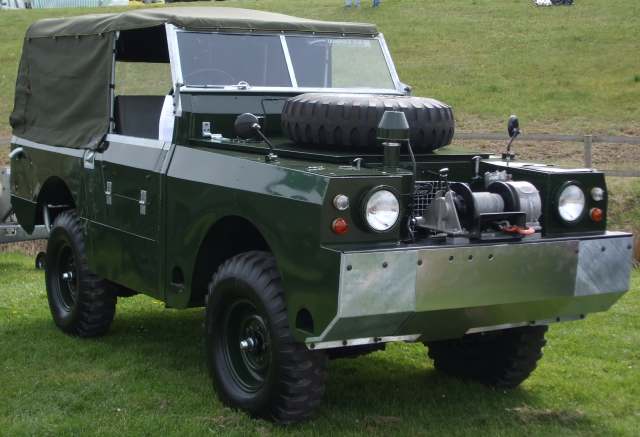
It has a boat shaped hull at the front with large bumper bar and winch, as well as the fold down side doors for the driver and front passenger.
The body is built-up from 3 separate units, of rigid construction, replacing the rubber floats of the earlier design.
When in use, the water goes into the engine bay about half way up the engine block.
After extensive trails, including a run on Canberra’s Lake Burly Griffin, the project was a cancelled.
This was partly because of the water pollution.

prototype One-Ton Amphibious Land Rover
Australian prototype 'One-Ton Amphibious Land Rover'

Royal Marine Amphibious Lightweight.

Some Lightweights were specially prepared for deep wading between landing craft and the beach by the Royal Marines own workshops.
To protect against salt water special anti-corrosion treatment was added as well as adaptations to the engine fan, air intake, fuel tank, gearbox, transfer box, battery, and most importantly the electrical systems.
The vehicles had a very reduced life span due to the harsh environment they had to work in.

However, very few truly amphibious versions were ever produced.
Instead, Royal Marine drivers learned how to waterproof standard military Land Rovers for amphibious landings.
This was (and still is) done at the Amphibious Trials and Training Unit Royal Marines, at Instow in Devon.
The process involved fitting special seals, bladders, etc. to key components, and the course culminated in the drivers putting their skills to the test for real, either in the wading tank at Instow, or off the deck of a landing craft. 

The vehicles could wade deeper than the drivers, who had to hold their breath underwater while a (standing) colleague gave them steering directions by nudging them on the shoulders.

Deep wading
(very) deep wading.

Not all vehicles were successfully waterproofed, which is why all were fitted in advance of the test with a tow chain ready shackled to the chassis, to allow the Beach Armoured Recovery Vehicle (a waterproofed Centurion Tank variant) to pull them to safety.
The current in-service Royal Marines Land Rovers have been specified to make this process easier, which is why they are pre-fitted with ‘snorkel’ air intakes, and other features.

1988: Amphibious Defender 90

This adaptation of a Defender 90 was basically an updated version of the airportable series IIa float design.
This vehicle was built purely as a marketing tool for Land Rover to attend Cowes week, off the Isle of Wight
An amphibious Discovery series 1 was used the next year.
The 90 was recently restored, and was "driven" along the Caledonian Canal between Fort William and Inverness, in Scotland, a distance of some 60 miles.
The vehicle was fitted with the 2.5 Turbodiesel engine, and bears the honour of being one of only three 40th anniversary vehicles.

Amphibious Land Rover
Amphibious Land Rover.

2001-Present: The SeaRoader

The development of the original SeaRoader prototype was begun around 2001.
Developed by Mike Ryan, the prototype underwent many tests and revisions before the first production machine was built in 2006.
The machine is based around Defender 110 running gear and 200tdi engine.
It uses a second engine for water propulsion, a 2 cylinder Beta marine diesel unit, with a F/N/R gearbox.
The chassis and all body panels are specially made for this vehicle.
Various applications and options are available and have been fully tested.
The vehicle can be purchased fully built, or as a kit.
For more information, visit www.searoader.com.

SeaRoader Amphibious Land Rover
SeaRoader.
Picture © www.searoader.com

SeaRoader Amphibious Land Rover
SeaRoader.
Picture © www.searoader.com

Help us with our research!

If you can help us out with more information regarding any of these Land Rover applications, please do so.
In the first instance, contact us at admin@lr-mad.co.uk

Visit the 4x4 Prejudice website.

Get the facts about 4x4's

www.4x4prejudice.org


back to top

back to top

Links :

Searoader

The Dunsfold Collection

If you know of any good links, e-mail me

If you have, or used, an amphibious Land Rover, please drop us a mail


Remember to e-mail us if there is any help or advice you can give.

If you have any questions about this site,
please e-mail us.

To e-mail, click here


Home | Marque History | Series I | Series II/IIa | Series III
Stage 1 V8 | Range Rover | P38 Range Rover | Range Rover L322 & Sport
Forward Control | Lightweight | 90/110/Defender | 6x6 & 6x4 | Minerva
Santana | Otokar | Tempo | Morattab | Tracked & Half-Track
Emergency Vehicles | LR-Mad Project | Stretched LRs | Conversions |
Prototypes | One Ton | Discovery | Freelander | Amphibious
Forest Rover & Ag-Rover | Custom & Hybrid | Armoured
Carawagon & Dormobile | Access Platforms
COPYRIGHT © 2005-2008 www.lr-mad.co.uk   


back to top