...Have you got it?

Armoured Vehicles

Royal Ulster Constabulary Land Rovers

The Shorland Armoured Patrol Car which started the trend for armoured Land Rovers back in the early 1960s. However, the Royal Ulster Constabulary can trace its Land Rover roots back to Series Ones in the 1950s, and in fact Series One Land Rovers were still in use in the late 1960’s and possibly into the early 1970s.

Shorland Prototype
Shorland Prototype.

The Shorland Armoured Patrol Car was designed specifically for the Royal Ulster Constabulary, during the 1960s. It entered service around 1965, and it was to be used for patrolling the border with Eire (Republic of Ireland), to prevent organised smuggling which was rife at the time. The vehicles were built by Short Brothers and Harland in Belfast, Northern Ireland.

Final Shorland Prototype
Shorland Prototype.

Over the years there have been several versions, including the Mark 1 & Mark 2 Series IIa 109" based units, the Mark 3 & SB301 series III 109" based units and Mark 4 & SB401 Stage 1 V8 Based Units. The S50 versions of the Shorland was based on the 110" coil sprung chassis. Short Brothers were bought by Bombardier, which is now part of Tenix Defence, whose S600 range of armoured vehicles is based on the Unimog chassis.

The original Shorland design was based around the civilian version of the Series II 109", but later designs used the military specification vehicles. The Shorland had a turret on the roof similar to that fitted to the 'Ferret' Armoured Car, and it was fitted with a Machine Gun. During the civil unrest of 1969/1970, they were deployed in Belfast, and in fact the machine guns were fired in anger during this period. However in 1970, the Shorland fleet was reallocated to the newly formed Ulster Defence Regiment and repainted in Army Green instead of the Battleship Grey which was in use by the Royal Ulster Constabulary, which had unsurprisingly been in ready supply at the Belfast Ship Yard where they were made.

Shorland pic © www.landroverclub.net

Shorland MK 5 Prototype
Shorland Mk5 Prototype.

This early version of the Shorland is referred to as the classic Boat tail Shorland, as later, more modern designs used worldwide from TV crew to military and by the Royal Ulster Constabulary, followed the more traditional Land Rover boxy shape. Indeed in most versions the turret was deleted from the design.

Shorland pic © www.landroverclub.net

Other designs of Land Rovers used in Northern Ireland by the Royal Ulster Constabulary included the RUC Makrolon Land Rover with Plastic Protection Kit, which was based on the civilian Land Rover Series III 109" and the RUC Hotspur Land Rover with Armoured Steel Protection Kit, again based on a civilian Series III 109" Land Rover. Both of these Land Rover Models look similar to the Army VPK Series III Land Rover referred to as the Piglet.

With the introduction of the Land Rover 109" V8 (the Stage 1) by Land Rover, an upgraded version of the Hotspur machine becomes available fitted with the Land rover V8, and it became simply known as the RUC Hotspur V8 Land Rover. Again it was fitted with armoured Steel Protection Kit and based on the civilian V8 Land Rover. Contrary to popular belief, very few of the Royal Ulster Constabulary's armoured Land Rover fleet, which numbered around 450 at its peak, were actually built by Short Brothers and Harland. In the early days the Hotspur vehicles, built by Hotspur Cars Ltd. in Wales, formed the basis of the armoured fleet.

New versions of the Shorland became available, this new design was an Armoured Personnel Vehicle. Both Series III 109" and Defender 110 models based on military specification chassis were used. The new vehicle was totally different in design to the classic boat tail, which could only carry a driver, observer and gunner. The later Shorland design could carry a further six men in the armoured rear tub. This type of the Shorland was still patrolling the streets as late as 1988. To the untrained eye, all battleship grey Royal Ulster Constabulary Land Rovers look the same, but the Shorland armoured personnel vehicle is actually quite easy to spot, due to its single piece armoured crew tub sides with a fold line, were the usual Land Rover barrelling should be located and the inward sloping tuck of the lower body sides. A similar vehicle is still available today based on the 110 chassis, but is now built by Otokar.

Otokar Akrep
Otokar Akrep

Police Support Officer Mr Ernie Lusty was a pivotal figure in the move by the RUC to build their own armoured Land Rovers. Mr Lusty was involved in the use and design of Land Rover hybrids in Kenya in the 1950's, where he was a Police Transportation officer. In addition to Land Rovers he was involved with the design and construction of executive armoured sedans for British Government ministers. Ernie Lusty was the head of the design team for the Simba , Shenzi and Tangi armoured Land Rovers. He led the development of new armour types which saved the lives of many Royal Ulster Constabulary officers. For his contribution he received the O.B.E in 1990.

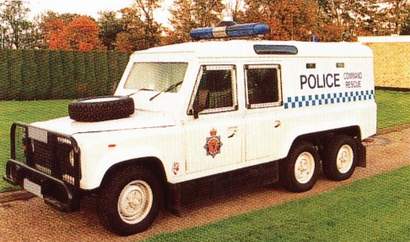
The RUC 'Simba' Land Rover model was designed with further protection in mind for the Officers of the Royal Ulster Constabulary who had to endure much greater risks on the streets from high powered guns and RPG Rockets and mortars. It features a twin layer armoured steel body and it is based on a civilian Land Rover 110 with its chassis widened by six inches.

The latest version of the Armoured Land Rovers designed by the Royal Ulster Constabulary GC is the 'Tangi', it features an armoured steel body and reinforced roof and is based on the civilian 110 V8 Land Rover. The reinforced roof came about due to the fact that improvised bombs made out of coffee jars had been dropped out of buildings onto passing Land Rovers, causing damage to the Land Rover and injury to the Police Officers inside. The Royal Ulster Constabulary Tangi Land Rovers were designed and built by their own vehicle engineering team based at Seapark, just outside Belfast.

All Royal Ulster Constabulary Land Rovers were painted Battleship Grey up until 1999. From then on, new vehicles added to the fleet were painted white with a red stripe down the side and the Crest of the Royal Ulster Constabulary on both doors. When the Royal Ulster Constabulary was renamed the Police Service of Northern Ireland at the end of 2001, all the Land Rovers still painted in battleship grey were repainted in white, and all of the vehicles were updated with the blue and yellow Battenberg livery so familiar to those on the UK Mainland.

Tangi Armoured Vehicle (Grey livery)
The Tangi armoured vehicle was designed and built by the RUC’s own vehicle engineering team.

Tangi Armoured Vehicles (PSNI livery)
Tangi Armoured Vehicles in newer PSNI livery.

The Tangi is still in service today with the Police in Northern Ireland, and is used in a number of roles now, from having a Camera attached to its roof and used by the Photography Branch to record events such as crowds at a football match or band parade, to being used by the Road Policing Branch and having a mobile speed camera set up in it. A number of UK mainland Police forces are also now using the Tangi, including North Yorkshire and possibly Humberside.

As for non-armoured vehicles, both the Royal Ulster Constabulary and the Police Service of Northern Ireland continue to use Land Rover Products. The Royal Ulster Constabulary used early two door Range Rovers, and later the P38 Range Rover, for Traffic Duty. The Mountain Rescue Branch also used Land Rovers. Today the Police Service of Northern Ireland have on its fleet the latest version of the Range Rover for Traffic Duty, and also employ Land Rover Defender 110 Station Wagons around Costal Areas. All sport the new Battenberg Livery, the Defender in white, while the Range Rovers have been seen in both white and silver. Land Rover Defender 90s are used by the Anti-Social Behaviour Unit, which tackles Youth Crime etc, in plain and liveried guise.

Many thanks to Dereck McCready for this information.

The Norland

A relatively new armoured Defender design. Research is ongoing, any help appreciated.

The Rhodesian 'Rhino' and 'Kudu'

The downsides of flat-bottomed armoured vehicles are obvious where landmines or roadside improvised explosive devices are encountered. The Rhodesian 'Rhino' and 'Kudu' were Land Rover based patrol vehicles with shaped bodies to deflect the blast wave from such devices. Mine resistant vehicles of this type were first produced Rhodesia (now Zimbabwe) with a series of unusual, mine-resistant types set on truck chassis. The early vehicles were mostly built as mine-detector vehicles, but they showed the way with high ground-clearance and monocoque crew compartments with a V shaped bottom. The 'Rhino' and 'Kudu' vehicles were simply a V-bottomed crew cab perched on top of the Land Rover chassis. Crude as they were, these knocked-together vehicles were the first truly mine-resistant and therefore blast-resistant armoured personnel carriers. As conversions of existing types, Rhodesian mine or blast-resistant vehicles were quick to construct and made use of readily-available components. This did not go unnoticed in neighbouring South Africa, who took the idea further with their own (non-Land Rover) designs.

Rhodesian Rhino Rhodesian Kudu
(left) The 'Rhino' patrol vehicle.  (right) The 'Kudu' patrol vehicle.
Kudu pic © Chick Van Moerkerken.

Help us with our research!

If you can help us out with more information about armoured Land Rovers of any type, please do so. You can contact us at admin@lr-mad.co.uk.

Custom Search