Land Rover Madness Stretch 6x4 Land Rover
Home Marque History Series I Series II/IIa Series III Stage 1 V8
Classic Range Rover P38a Range Rover Range Rover
L322 & Sport
Forward Control Lightweight 90/110/Defender
6x4 & 6x6 Minerva Santana Otokar TempoMorattab
Tracked & Half-Track Emergency Vehicles LR-Mad Project Stretched Land Rovers Conversions
Prototypes One Ton Discovery Freelander Amphibious Forest Rover & Ag-Rover
Custom & Hybrid Armoured Vehicles Carawagon & Dormobile Access Platforms

Emergency Vehicles.


Fire Engines

Land Rovers and Range Rovers were particularly popular choices for fire engine and ambulance conversions.
The Land Rover was a good base for an off-road appliance, whilst the Range Rover offered speed and size for airfield operations, in it's TACR 2 guise.
The Land Rover was especially useful for rural brigades, where its cross-country capabilities could get fire-fighters to a remote blaze in an isolated farmhouse or a gorse fire on a mountain very quickly.
Nor was its use confined to country areas, with many large urban brigades using the Land Rover to support bigger appliances or as specialist vehicles.
Land Rovers found favour with industrial brigades, often serving as towing vehicles for trailer pumps.

Initially Land Rover sold its own fire appliance based upon the Series I 80", but they soon realised that they were not well equipped to produce a good range of fire appliances.
Therefore a number of specialist manufacturers were licensed to produce fire appliance and ambulance conversions.
Of these manufacturers, HCB Angus and Carmichael & Sons of Worcester (now Amdac Carmichael) are of particular note.
Carmichael did various models, including 4x4 and 6x6 Range Rover conversions and FC conversions.

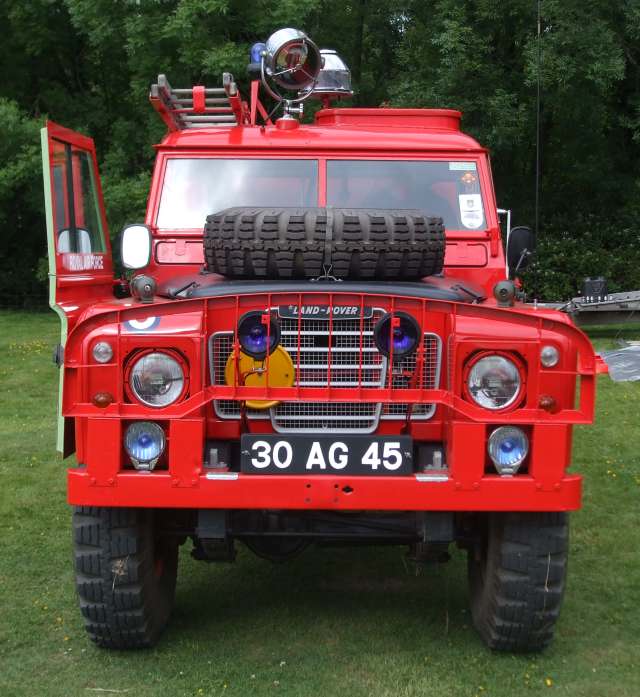
Sandringham 6 Fire Appliance. Sandringham 6 Fire Appliance.


Stage 1 Based Emergency Vehicle.


Series III Forward Control Fire Appliance. Carmichael Series III Forward Control Fire Appliance.


Pictures:-
Top left, Sandringham 6 based fire appliance.
Top right, Similar Sandringham 6 based fire appliance.
Middle, Series III 109 V8 based emergency vehicle.
Bottom left, Series III forward control fire appliance.
Bottom right, Carmichael Series III FC fire appliance.

Ambulances

Military Series I

The MoD began to use Land Rovers as military ambulances from 1954, when a small number of vehicles were ordered by the RAF for airfield crash rescue use.
These were produced on the 107" chassis, designated FV18005 Truck 1/4 ton Ambulance Special they were designed to carry either two stretcher patients or up to eight seated casualties.
The vehicles were so successful that they were soon in service with the Royal Navy’s Fleet Air Arm.
The army got its own fleet of vehicles designation type FV18008 Ambulance 2-Stretcher 107".
The rear body of these vehicles were slightly modified, the height was reduced and the vehicle became shorter than the FV18005.

Military Series II

The first of the MoD Series II 109" ambulances were produced by Mickleover Transport, subsequent vehicles were produced by Marshalls of Cambridge.
Both were designated type FV18044.
The specification for these vehicles called for the height to be lowered from that of the Series I:- this was to allow it to be flown inside RAF transport aircraft of the day.
A distinctive chamfered lower rear body was introduced which gave increased departure angle to improve off-road mobility.
Like its predecessors the vehicle was designed to carry either two stretcher patients or up to eight seated casualties and any medical attendants were shut in the back until the vehicle reached its destination.

Military Series IIa / III

The conversation coachwork was again by Marshalls utilising the 109" chassis these vehicles were designation FV18067.
The vehicles benefited from the addition of front and rear anti-sway bars.
The distinctive chamfered lower rear body continued from the predecessor as did the rear compartment being closed off from the drivers cab, and the payload capacity was still to carry either two stretcher patients or up to eight seated casualties.
The second batch of vehicles produced from 1964 saw the introduction of 2 high level foldout rails:- these were fitted to take a second pair of collapsed stretchers.
The Territorial Army were known to be still using Series IIa vehicles as late as 1997.
The Series III version used the same body shell as the Series IIa.
Both types continued in service side-by-side.

Series IIa ambulance.


General service vehicles were also utilised for ambulance use.
Known as Forward Area Ambulances, these had two stretcher frames fitted over the rear cargo compartment, an extended canopy was used to cover the patients.
F.A.A.s were only used to get casualties from the front line to more suitable vehicles or first aid posts.

Forward Control / 101

The Forward Control Land Rover was introduced in 1961 on a 109" Series IIa chassis, these vehicles gave a large solid platform coupled with excellent off road capabilities.
The wheelbase was increased to 110" in 1966 and this vehicle was designated Series IIb making it a variant in its own right.
The shorter wheel based 101 1-tonne was introduced in 1975, the conversion was done by Marshalls of Cambridge.
The 101 became very popular and much in demand in the ambulance role with the military.
This vehicle could accommodate 4 stretchers and was equipped with a self-contained air purification system.
These vehicles complemented the more traditional Land Rover ambulances, rather than replacing them.
Prime users of this vehicle were the amphibious, airborne and airmobile brigades.
The vehicles saw service in the Balkans with British peacekeepers and served long after the 127" vehicles were available.

101 FC ambulance.


Range Rover

The Royal Navy used Range Rover crash rescue ambulances at it's Fleet Air Arm stations.
Range Rover ambulances were produced by a few 'approved' specialists, including Pilchers, Spencer Abbott, Wadham Stringer and Herbert Lomas.
The vehicles below is based on the more common 110" stretched chassis.

Range Rover Ambulance.


Wadham Stringer Range Rover Ambulance

This Range Rover is one of the pre-production Velar vehicles and it was the first to be stretched and converted to an ambulance.
The ambulance body was built by Wadham Stringer.
It was owned and used by the British Red Cross until 1991.
YVB 158H was purchased by Dunsfold in 2001.
Many original Velar features still exist like the smooth dash and aluminium bonnet.

Range Rover Ambulance Number 1.


135" Lomas Range Rover Ambulance

Nick Steggel got in touch with us about his family's RR ambulance.
The vehicle is a 135" wheelbase Herbert Lomas ambulance, based on the already stretched Lomas 110" ambulance.
The original base vehicle was a 100" Range Rover chassis cab.
(Spencer Abbott were sub-contracted by Land Rover to do the 110" chassis conversions in quantity.)
It is believed to be the only five door Herbert Lomas ambulance based on the five door RR.
It uses the Rover 3.5 litre V8 engine to get about, and has been converted into a campervan on the inside.
Currently it is left hand drive, but it is believed to have been built as a right hand drive machine, then converted for use in Saudi Arabia as a test vehicle.

Range Rover Ambulance.


90, 110, 127 & 130 Defender

The St. John's ambulance service use Defender based vehicles within its fleet; the coachwork conversion is carried out by Macclesfield Motor Bodies International (MMBi).
Such vehicles were pressed into service during the 2004 Boscastle flooding when the local ambulances could not cope with the harsh conditions.
The MoD Defender ambulance fleet was based on the 127" wheelbase.
These vehicles were bigger, faster, more comfortable and more practical than their predecessors.
It was almost possible for the attendant crew to stand upright in the back and access was now possible between the driver’s cab and the rear of the vehicle.
A partially tinted window ran along the right side of the rear of the vehicle and large square tinted windows were set in each rear door.
They were designed with a rear to accommodate three stretchers or to seat eight although the seating was still more realistically suitable for Six.
These vehicles were widely operated by the RAF and the Royal Navy although a small number served with specialist army units.
Some Royal Navy vehicles had the rear compartments kitted out to meet different specifications.
At least two batches of very similar vehicles were produced based on the later Defender 130 (127") chassis.
The two-piece angular front panel over the cab can be used to identify these vehicles from the earlier 90-110 vehicles.

Red Cross Ambulance at Abingdon. 110 ambulance in the snow.
Defender 110 based ambulance. 110 ambulance on the moor.
Defender 110 based ambulance. 110 in the snow.


Pulse

The Defender 130 XD, code-named Pulse.
In 1996 Marshall Specialist Vehicles was awarded a contract to supply new field ambulances to the British Army.
The vehicle is powered by the 300 Tdi engine, with permanent four-wheel drive and five forward gears.
It is based on a 130" wheelbase version of the XD (Wolf) Range Rover derived chassis, not the civilian Defender chassis.
The Pulse is mechanically identical to the Wolf except for its upgraded suspension.
The Dutch Marines were the first armed forces to take delivery of the vehicle, closely followed by the MoD.
The Pulse has now replaced all but a few of the 127" ambulances in British Army service.
The Turkish company Otokar also builds a home-grown version of this vehicle.

XD 130 Pulse ambulance.


Police Vehicles

Police versions of Land Rover vehicles have been around almost as long as the vehicles themselves.
In much the same way that the fire engines were developed to reach those remote spaces, the police versions of Land Rover products were vigorously promoted as go-anywhere criminal-catching type machines.
Both Discovery and Range Rover also found favour as motorway patrol vehicles, their versatility and road presence obviously being key factors.
Below are some of the more modern examples of British and European Police Land Rovers.

Metropolitain Police Discovery II. Police 110.


European Discovery Police Vehicle. British Transport Police Defender.


West Yorkshire Police L322 Range Rover. Police P38 Range Rover.


Rescue Services

Mountain Rescue teams, The Coastguard, and other rescue services often would be at a disadvantage without their Land Rovers.

Tayside Search and Rescue Defender. Silverstone Racetrack Fire and Rescue vehicle.
Coast Rescue Defender.
Mountain Rescue Defender.


Help us with our research!

If you can help us out with more information regarding any of the Land Rover applications mentioned here, please do so.
In the first instance, contact us at admin@lr-mad.co.uk


back to top

back to top

Land Rover Emergency Vehicle Links :

Series III FC Fire Engines of Northern Ireland

If you know of any good links, e-mail me


Remember to e-mail us if there is any help or advice you can give.

If you have any questions about this site, please e-mail us.

If you own or have information on any of these types of vehicles, please e-mail us.

To e-mail, click here


Visit the 4x4 Prejudice website.

Get the facts about 4x4's

www.4x4prejudice.org


TACR 1 Airfield Fire Truck.

TACR 2 Airfield Fire Truck.

FC 101 Ambulance.
FC 101 Ambulance.

Ambulance.
Ambulance.

P38 Range Rover Police Vehicle.
P38 at Gaydon.

Hungarian Defender Police Vehicle.
Hungarian Defender Police Vehicle..

Hungarian Defender Police Vehicle.

Police Discoverys.
Discoverys.

Series Police Vehicle.
Michel Brams 1951 Series I Police vehicle.

Series Police Vehicle.
Michel Brams 1973 Series III Police vehicle.

Discovery fast response ambulance.
Discovery ambulance.

Czech armed forces ambulance.
Czech military ambulance.

Santana ambulance.
Santana ambulance.

Military Defender Ambulance.
UK Military Defender Ambulance.


Home | Marque History | Series I | Series II/IIa | Series III
Stage 1 V8 | Range Rover | P38 Range Rover | Range Rover L322 & Sport
Forward Control | Lightweight | 90/110/Defender | 6x6 & 6x4 | Minerva
Santana | Otokar | Tempo | Morattab | Tracked & Half-Track
Emergency Vehicles | LR-Mad Project | Stretched LRs | Conversions |
Prototypes | One Ton | Discovery | Freelander | Amphibious
Forest Rover & Ag-Rover | Custom & Hybrid | Armoured
Carawagon & Dormobile | Access Platforms
COPYRIGHT © 2005-2008 www.lr-mad.co.uk   


back to top