Land Rover Prototypes
- Details
- Category: Prototypes
- Last Updated on Tuesday, 22 November 2011 20:20
- Written by Site Admin
- Hits: 10772
The Rolls Royce B40 Engined Land Rover.
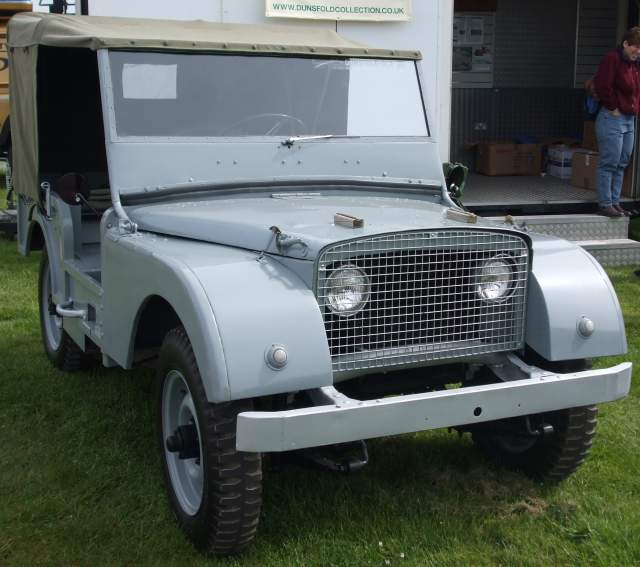
The British Army wanted to introduce common mechanical parts across its military vehicles and commissioned 33 prototype Land Rover 80" Series I's fitted with the Rolls Royce B40 engine, as used in the Austin Champ. The Rolls Royce B40 engine was larger than Land Rover's own 1.6 litre unit and this meant the radiator had to be moved forwards and the bonnet raised slightly at its leading edge. The wheelbase was also adjusted slightly to 81 inches. The B40 Land Rover was allegedly a very accomplished machine, and very quick, however the experiment was too costly and simpler military adaptations of the standard civilian Land Rover proved much more successful in the long run.

Land Rover B40 prototype - pic © L. Allison
1962: The 129" Truck Project
There were five prototypes built for military trials for the Belgian Army in the early sixties. Dunsfold and Gaydon each have a 129" truck prototype. This design has a 129" wheelbase, 9.00x16 or 11.00x16 tyres, and 2.5 litre 4-cylinder turbo-diesel (with a 5 main bearing crank and a CAV turbo and intercooler, Land Rover's first try at a turbo-diesel engine), or 2.6 litre 6 cylinder petrol. The 129" has the leaf springs over the axles, and the load capacity is 35cwt. A four-speed 'crash' (no synchromesh) gearbox with a much larger oil capacity is coupled up to a special remote transfer box with a tyre inflation set up. Most of the cab section derives from the ordinary Land Rover of the day.

Two of the Land Rover 129 inch truck prototypes
1963: 'Two Tonne' Forward Control Truck Project
This project was short lived indeed, another push at 'bigger' Land Rovers. It was at the request of the MoD that Land Rover developed this 'two tonne' forward control model at the end of 1963. It had a 24 volt electrical system, and was equipped with the most powerful petrol engine Rover had at the time, the 3 litre, six cylinder engine from the Rover P5. The MoD wanted a diesel version, and an agreement with Perkins gave Land Rover access to the Perkins 5.8 litre, 6 cylinder engine. The vehicle was equipped with a five speed gearbox, made by Turners of Wolverhampton, coupled to a transfer box manufactured by All Wheel Drive.

Land Rover FC 'two tonne' truck prototype

Land Rover FC 'two tonne' truck prototype
At the beginning, the MoD wanted a large vehicle, and so the wheelbase was set at 129 inches. But as testing progressed, the wheelbase was changed to 120 inches and then to 112 inches. Despite Land Rover's best efforts, the MoD finally decided not to make an order for these vehicles. Another prototype was built, this vehicle being adapted as a transporter for the Rover-BRM Gas Turbine Racing Car. This machine was front wheel drive only, utilising a similar drivetrain to ‘Buttercup’ but only using the front drive output from the transfer box. The rear bed of the truck raised and lowered utilising hydraulic rams to allow the vehicles to be loaded and unloaded. Buttercup was kept by Land Rover and used as a recovery truck and general runabout. An attempt was also made to prepare the vehicle for the civilian market, but development problems with the Perkins engine meant the project could not continue.

'Buttercup' Land Rover FC 'two tonne' truck prototype.


'Buttercup' at the Dunsfold show 2009.
1965:The "Big Lightweight" 3/4 ton gun tractor.
Also known as the 110" Bonneted Control Land Rover, the 3/4 ton was a private venture by Land Rover to produce a 'lightweight' type vehicle designed for pulling power-driven trailers and the British Army's new 105mm gun. It was similar in style to the 1/2 ton and used some components from it. It was powered by the Rover P5 3.0 litre 6 cylinder petrol engine, producing 110bhp. The vehicle was fitted with one-ton spec. Dunlop Track grip 9.00x16 tyres. The wheelbase was 110", with a second transfer box to drive the trailer/gun axle, allowing 2,4,or 6 wheel drive. It only reached prototype stage in 1965 with just 3 being produced. Two are thought to still exist, and one of these is in the Dunsfold Collection.
The theme was picked up again with the development of the 101" forward control vehicle, the one tonne.

3/4 ton 'Big Lightweight'.
1976-1986: The Land Rover 100" Prototypes
1976: The prototype 100" (wheelbase) Land Rover was originally built on a Range Rover chassis, and so became the first coil-sprung 'Land Rover'. The inner front wings were cut to make place for the suspension turrets. The front of the vehicle is Stage 1, which was not yet in production. Over a number of years, Land-Rover experimented with different wheelbases and spring configurations. Land Rover set up a development team to set up a short and a long wheelbase version of this vehicle, i.e. the 90 and the 110. However money being tight, the project was hampered until the Swiss Army showed an interest in the existing 100" version. The 100" was being developed mainly towards military sales, and so were actively promoted around 1978/9 to the Swiss and French military. In 1978 a fleet of 15 vehicles was built for the Swiss. They were constructed from a collection of parts from Series III, Stage 1's, 110's and Range Rovers. It is believed that they covered every combination of left-and right-hand steering, engines etc. In the end both countries bought other products. The project continued, and over time went through at least 70 experimental versions. Various body styles and engine configurations were experimented with, from 2.25 litre Diesel Soft Tops to 3.5 litre V8 Station Wagons. The project was ended with the release of the '90', and many of the prototypes were destroyed or sold on to Land Rover employees.

Land Rover 100 inch prototype.

1979 Land Rover 100 inch prototype.
1986: The Llama Project
The Llama is another interesting prototype, and quite possibly the best one they never made. Designed and developed in the mid 1980s as the successor to the 101 Forward Control, a number were built for evaluation by the Ministry of Defence. The Llama used the chassis and many parts from the relatively new 110, so was permanent 4x4, and was fitted with the 3.5 litre Rover V8. The 2.5 litre turbodiesel engine was also tested, but was not powerful enough. The vehicle was fitted with a Santana LT 85 gearbox, and power steering. It had wider than standard axles. The Llama also had a very modern tilt-forward fibreglass cab (to reduce weight), instead of the aluminium box cab of the 101. Ten prototypes and two pre-production vehicles were built. However the project was cancelled as the MoD had opted to order the diesel powered Pinzgauer as the 101 fc's replacement and Land Rover couldn't compete in the civilian market without a good diesel variant. Only a few remain, with one on display at the Heritage Centre.

Civilian Spec Llama Prototype

Land Rover Llama prototype.
1991: The 'Juno' prototype (Challenger project)
This is the last surviving prototype of the Land Rover 'Challenger' project from the early 1990's. (three vehicles were built, but the others were crushed) The Challenger project was initiated due to increased competition in the military supply sector from foreign manufacturers. Ever since the Series I, Land Rovers had served the military in almost every country in the world. But as the Defender design became older and more expensive, more and more governments started to look elsewhere for their defence vehicles. A quality replacement was needed for the Defender, and so a new vehicle had to be developed.
The 'Juno' is based on a Discovery 1, though the chassis is slightly longer at 115" wheelbase. The interior is straight out of a Discovery 1, with just an additional binnacle on the dashboard for extra switches and instruments. The power plant is a heavily modified 200 Tdi unit, itself a prototype of the 300tdi. It employs a Range Rover automatic gearbox.
Eventually, although it was a very capable vehicle, it was not thought to be versatile enough for general military use. However, the research undertaken during the 'Challenger' project was used in project 'Wolf' to develop the Defender XD. The prototype shown below is now owned by the Dunsfold Collection.


Juno Cabin Area
1997: Land Rover LCV (Lightweight Concept Vehicle) project
Faced with ever-rising fuel prices and more stringent total vehicle emissions legislation, Land Rover initiated a programme of work in the early 1990s to investigate lightweight technologies for their production 4x4 vehicles. The Lightweight Concept Vehicle (LCV) programme planned to investigate and develop new technologies, culminating in a vehicle that would enhance Land Rover’s off-road ability and achieve a combined fuel economy of 40mpg.
The first vehicle in the programme, code-named LCV 1, was based on a Discovery 1. The vehicle weight was reduced by replacing the steel chassis and body panels with aluminium replicas. This produced encouraging results, but showed that an all-aluminium vehicle required specialist design. The second step, LCV 2, produced several prototypes based around the appearance of a Defender 90 station wagon. Through the design of a unique bonded and riveted space frame, the strength and durability of the aluminium vehicle was comparable to that of a production Defender. This design approach resulted in a significant reduction in the overall vehicle weight (379 kilograms), giving a much improved fuel economy and increased performance with no loss of off-road ability.

LCV 2/3.

LCV 2/3.

LCV 2/3.
The final vehicle to be manufactured in the programme, the LCV 2/3, further developed the lightweight technologies to investigate their benefit on vehicle performance. The LCV2/3 was built as a 'taster' of what was planned for the LCV 3 project, which never got underway. The space frame design philosophy and construction techniques were essentially the same as those employed for LCV 2. The upper structure, however, was redesigned to accommodate the change of body from station wagon to pick-up and the development of the style to improve overall vehicle aerodynamics. A fully revised cab interior also brought the vehicle up to date. The vehicle was fitted with an aluminium 2.5 litre 174bhp V6 petrol engine (KV6) to improve the vehicle’s performance. There were many reasons why this project stopped. The cost of repairs to damaged vehicles built in this fashion, and the associated investment required in main dealer facilities were but two.
2003: The Range Stormer Concept Vehicle
The Range Stormer Concept vehicle was Land Rover's public introduction of the idea of a 'smaller' and 'sportier' Range Rover product. The concept came to fruition in the form of the Range Rover Sport, which is aimed at the "sports car 4x4s" such as the BMW X5, Mercedes ML, VW Touareg and Porsche Cayenne, with the idea of equalling their on-road performance while retaining the legendary Range Rover off-road capability. The outward design was diluted a little on the Sport, but it has proved to be a favourite with buyers.

Range Stormer Concept vehicle.
The 106" Discovery Project
In the early 1990's this prototype was produced, which gives extra space in the rear passenger compartment. From the grainy picture below, you may just be able to discern the extra panel and window between the doors. If you have more on this prototype, please e-mail us.

Land Rover Discovery 106 inch prototype.
Built for the CEO of British Aerospace in 1994, the vehicle below has been adapted with a 'filler' panel between the front and rear doors. This, we believe, is exactly the same as was done on the 106" prototype of just a few years previously.


Land Rover Discovery 106 inch.
2008: The LRX Concept Vehicle
The LRX Concept vehicle was Land Rover's took over from the Range Stormer project in pushing the idea of a smaller, greener 4x4 Range Rover. Now officially passed for production as the new 'baby' Range Rover, the Evoque, this concept will provide the benchmark at the luxury end of the 'crossover' 4x4 market. Typical competitors will be the BMW X3, Toyota RAV4 and Mitsubishi Outlander.

LRX Concept vehicle.
Dave Kennedy Wrote:
I worked at LR in the nineties as a chassis design and development engineer, and it seems that there could be a category of prototype vehicle that is completely missing, and will probably be very difficult to get any pictures of - which is a real shame as they were cracking vehicles.
Chassis engineering needed to start test and development work long before the first full pre production prototypes were ready, also some of the extreme abuse work that new chassis systems had to go through was too rough for a fragile prototype, so for programmes with big chassis changes like P38A and Freelander, they built 'chassis simulators'. For P38A the sims were stretched Range Rover Classic bodyshells grafted onto the P38A chassis. They differed from the LSE classic by having a stretched BC post rather than the stretched rear door of the LSE version. They were all I think painted matt army green with base cloth interiors. The two vehicles I was involved with Sim 53 and 54 had 4.2 engines built by JE Racing to try and simulate the expected power output of a planned supercharged V8 that sadly never made production.
When the Gaydon collection was being put together we did suggest that one of the simulators should be saved but to the best of my knowledge they were all destroyed. They were used for chassis abuse testing, and brakes and traction control development, handling and tyre work that I know of, but I'm sure that other areas used them as well. The other vehicle that is interesting is the CB40 simulators, these were used for developing the chassis and power train for the Freelander, basically they were Freelander mechanicals grafted into modified Austin Maestro van bodyshells - picture a jacked up Maestro van with Freelander wheels, They looked hmm interesting but allowed the CB40 chassis and powertrain to go out on extended mileage long before the program was announced.
I don't know if you'll be able to get any pictures of these unusual vehicles but they are an interesting and unusual little slice of LR history.

No P38a mule pics yet, but this Freelander chassis test vehicle is looked after by the Dunsfold Collection.
Emma-Claire Dunning Wrote:
I have worked at Land Rover and associated companies for 20 years (still do). I also worked at Land Rover Classic Parts, the ill-fated classic parts supply venture between LR and Unipart.
I have a little bit of info about some prototype Land Rovers I have come across and/or worked on over the years...
Firstly "Challenger". I had the pleasure of driving one of the three prototypes. One was used for crash-testing. One was used to showcase the military guise (this one is preserved at Dunsfold and pictured above). The third car was the one I drove, and was painted a mid-blue colour, one of LR's standard Defender/Disco colours, and was shown in civilian form as a proposed updated concept for Defender. Basically to update the vehicle with better NVH, ergonomics, drag (sloping windscreen), luxury (electric windows), etc... it was proposed to use the front cabin from the Discovery I, from front grille back to the B-post, and then have the rear (load area) as per current Defender. This vehicle had a 200Tdi engine and manual gearbox with LT230 transfer-box. It was finished well and looked like a plausible defender update, and it drove like a Disco I as well. Sadly it was crushed.
Secondly, as an adjunct to Dave Kennedy's comments above concerning the stretched Range Rover Classic Simulator vehicles used as test and development mules for the P38A project:
I had the dubious honour of driving (well, steering as it was pushed) the last of these vehicles to the scrapyard at Solihull site. There were 10 of these vehicles, and this last one was painted black. They were stretched as Dave says, the stretch being taken up by having much wider B/C posts. This last car was an automatic, and was fitted with a special engine (I am not sure if they all were) which was a 4.2 litre V8 petrol, supplied by JE Racing.
As the proposed 4.6 litre V8 engines for P38A were not available at the time these cars were built, JE were asked to modify the existing LR 3.9 litre V8 engine to give it a representative power output that the 4.6 litre engine was expected to have. In actual fact, these special engines had a higher output than the 4.6 litre V8 eventually had, as JE had basically added a lot of race-tuned upgrades, including mods to the cam, crank, capacity (up from 3.9 to 4.2) plus fuelling and exhaust upgrades. These special 4.2 litre engines developed about 250bhp, and sounded really rorty and gave a very spirited performance to the stretched RR Classic P38A Mules to which they were fitted. So much so that these cars were nicknamed the "Stimulators".
Sadly, the actual output of the production 4.6 litre V8 was only 220bhp. It was a great shame that all the "Stimulators" were scrapped. As the windscreen of this last car had been damaged, I cut my hand (across the knuckles) whilst steering it to the scrapyard, and I still have the scars to remind me of these great cars.
Thirdly, there was a little-known development test vehicle that had one of the longest lives (recently) at LR engineering, that I knew of.
It started life as one of the original Discovery I engineering test fleet vehicles, the project was known as Jay. The vehicle had a V8 engine and was painted blue. It was numbered J204.
For some reason, this vehicle just seemed to "stick around" with various justifications being used to continue it's existence at LR as a test car. So much so that it was re-bodied and converted into a Discovery II (project Tempest) with the stretched body being achieved by a wider D-post at the back. It also had the latest (at the time) Tempest V8 engine fitted, with the multi-intake plenum. I forget the name of this petrol engine program, the 5-cylinder diesel engine program was codenamed "Storm". So the life of J204 was extended as a Discovery II engineering development and test mule. It was given a new number from the Tempest program, I think it was 420, but I'm not certain, however we still referred to it as J204. It had a hard life, and sustained a lot of wear and tear during it's life. As far as I know, it was one of only very few (if any other) Land Rover test and development vehicles which was used on two separate consecutive vehicle projects. I really wanted this vehicle to be saved and not scrapped due to it's unique life at LR, but sadly this was not to be, and it was scrapped :-((
Lastly, I worked on the CB40 project for many years and had two of the Maestro Van mules as test cars. There were 22 of these CB40 mules, numbered M1 to M22. 20 of them were painted black, but two (M11 and M22) were painted white as these were the ABS/ETC/HDC test cars, and as such, spent a lot of time testing in the Arctic, so it was considered that white would be the better colour for these environments. M11 had the 2.0l diesel engine, M22 had the 1.8l K-series petrol engine.
These were the two mules that I drove the most. M22 in particular was a cracking good vehicle. As these mules were lighter than the eventual production bodied Freelanders, their performance was sprightlier, and they were surprisingly capable off-road. The modified Maestro bodyshells were all fitted with integral roll-cages. Only M11 and M22 had fully functioning (and regularly updated) ABS/ETC/HDC systems. I really wanted to buy M22 once it's test-program was over, as I had become quite attached to it, but alas this was not to be, and both M11 and M22 were scrapped.
As far as I know, at least two, maybe three of the CB40 Maestro Van mules were saved. I think two are at Dunsfold, and one at the Heritage Motor Centre.
I do know that M16 is definitely at Dunsfold (this is the one pictured on your website). This was the foundation-brakes dept. test mule, and had the K1.8 litre petrol engine. It regularly plied the brakes wear test route as part of it's duties, and I drove this vehicle occasionally. It still has the holes drilled in the front valance where we attached lead weights to get the corner (wheel) weights up to the correct level to represent a fully-laden Freelander.
Emma-claire Dunning.
Specialist Engineer (Braking systems),
JLR Advanced Chassis Research.
Land Rover Project Icon Concepts: DC100 and DC100 Sport
Derivatives of these designs could become the new Defender model.
If you can help us out with more information on Land Rover prototypes
(even ones we haven't mentioned!), please do so.
You can contact us at This email address is being protected from spambots. You need JavaScript enabled to view it. .
More prototype pictures

An early 101 FC Prototype (01 SP 14).

101 forward control prototype number 6 (01 SP 17).

The Land-e.

A replica of the centre steer prototype - Gaydon 2008