IIa, IIb, III, 101, 82, 88.
|
Land Rover Forward Control 1962 - 1980s
The Series IIa
The Land Rover Series II/IIa 109" did not have enough load capacity to satisfy some customers, so they developed a Forward Control (FC), or cab over engine, design for this
market.
The Series IIa Forward Control Land Rover contains the normal Series IIa 109" chassis, engine and running gear hidden under the truck bodywork.
A new sub-frame is bolted to the front of the chassis to carry the cab.
The cab itself contains some new panels but makes considerable use of standard Series IIa panels.
Land Rover saw this as a positive selling point for existing large volume customers.
The radiator is moved forwards and the fan is driven by its own mini prop-shaft complete with two universal joints.
Most forward controls came with a drop-side tray fitted to the rear.
This is supported by a sub-frame of U-channel girders and uprights bolted to the Land Rover chassis.
The arrangement is very strong but also heavy.
The engine is accessible via a cover which intrudes into the rear tray by a small amount.
The load area is large enough to carry an 80" Series I.
Standard tyre size is 9.00x16.
The vehicle was also available as a cab/chassis without the rear sub-frame or tray.
In this form it was popular for camper-conversions, fire appliances and other special projects.
Quite a few forward controls were fitted with a centrally mounted power take-off driven winch.
This is a very sensible position for a winch as the weight is between the axles and the winch rope can be run out either forwards or backwards through pulleys and fairleads.
Inside, the cab is almost all standard Land Rover Series IIa.
Most FC's were fitted with the short pick-up style cab.
Forward control steering is generally vague.
The vehicle is also nose-heavy and can be "exciting" when using the brakes, particularly down-hill, unless there is a bit of a load in the back.
The vehicle was also under-powered, as it was offered only with the 2.25 litre 4-cylinder petrol or diesel engines.
The top speed of a diesel powered FC is around 40 mph.
The total production run of the IIa FC is thought to have been around 3193.
Swiss IIa Fire Vehicle
US car dealer Findlay Automotive Group have recently purchased this Series IIa forward control.
It was previously a Swiss Fire Vehicle.
With only 14,500 miles recorded, they plan to revive the vehicle, and put it to good use as a promotional tool for their Land Rover Las Vegas dealership.
It is a 1964 model with the 2.6 litre petrol motor. Serial # 30300089B.
We will see more of this vehicle as it is updated.


Pictures © Land Rover Las Vegas:- www.lrlv.com
The Series IIb
Because of the problems with brakes, engine power and such, an improved Series IIb Forward Control was released in 1966.
It was offered with the 2.6 litre 6-cylinder engine as an option.
The most obvious external change was the moving of the headlights to a lower position and the sidelights to a higher position on the front panel.
The wheel base grew to 110" as the axles were moved slightly on the springs.
New axles with a wider track and heavy-duty ENV differentials were fitted.
However there were simply too many compromises in the Series IIa/IIb Forward Control and it was never a great success.
Most were used as work trucks; they worked hard and suffered accordingly.
Consequently FC's are now quite rare, straight and complete ones especially so.
The total production run of the IIb FC is thought to have been around 2305.
IIb production ended in 1972.
IIb FC number 1 has the much less powerful 2.25 diesel.
The load capacity was 30cwt, and top speed around 40mph.
The Marte FC
Information is sparse, but it is known that only around 30 of these vehicles were built by Marte.
The base vehicle is believed to be the Series IIb forward control, totally re-bodied in aluminium for their intended role, with a 7 seat cabin.
They were specified with the 2.6 litre, 84 HP, 6 cylinder petrol engine, and were supplied to the Fire Service in Austria.
As with standard IIb FCs, the tyres are 9.00x16 cross-plies.
The unladen weight is 2,340kg, whilst it's fully laden weight was 3,500kg.
The vehicle pictured at the bottom of the group of three is fitted with a functioning pump.


If you have more information on these vehicles, please get in touch!
The Series III
The Series III Forward Control was an evolution of the IIa/IIb design.
These were based on the series III 109" chassis, but were I believe not a Solihull-made vehicle.
Indeed it appears that these were manufactured by the specialist suppliers like Bates of Evesham, who converted around 52 vehicles into FC fire engines for the Northern Ireland Fire Brigade,
and Carmichael, who also produced some Series III FC Fire Engines.
The latter however are unlike any previous FC vehicle.
The series III FC seems to be a rare breed, and specialist variants like fire engines and ambulances make up most of the production.
You can find out more about the Series III FC fire engines of Northern Ireland on Liam's excellent Fire Engine site.
If you have any information, please e-mail us.
The 101 (the 'One Tonne')
In the late sixties the military were looking for a larger payload vehicle that could also tow a 4000lb light gun.
It was also needed to be capable of being carried by helicopter and hence could weigh no more than 3500lb in stripped down form.
It became apparent that a forward control model would give the best format for providing the load space required.
At that time, Series IIb forward control was available, but this did not meet the load/tow requirements and so Land Rover set about designing a new vehicle.
The Range Rover was just about to begin production and so it was decided to use the powerful 3.5 litre V8 engine from that model along with the gearboxes and centre differential.
This was all mounted on a new 101 inch leaf sprung chassis.
As with early Range Rovers, four wheel drive is engaged with a vacuum centre differential lock.
Large diameter 900 X 16 tyres (close to 36") are mounted on 6 stud rims driven by heavy-duty Salisbury axles.
The vehicle weighed in at 4040lbs, and the required 3500lbs in stripped down form.
This meant the vehicle could be carried by Wessex and Puma helicopters.
It could carry a one-tonne load as well as towing a 105mm gun across country.
The 101 Forward Control Land Rover was built for the MoD from 1975 to 1978 with a number of pre-production models dating from 1972-1974.
Roughly 2700 vehicles were manufactured in right and left hand drive, 12volt and 24volt models.
The chassis was unique to the 101, unlike the earlier series IIa/IIb and series III forward control Land Rovers that had shared the standard Land Rover long wheelbase chassis.
The majority of vehicles were General Service (GS) models, which were "rag-tops".
Three standard types of hard body 101's were also produced.
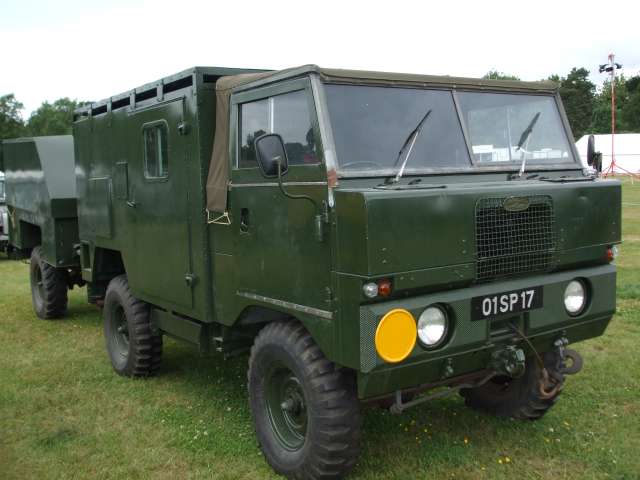
These were : 1) Ambulance Body (Approx. 300-450 made, body by Marshall's of Cambridge).
2) Radio Communications Body (Approx. 125 made).
3) "Vampire" Radio Body (Approx. 20 made, body by Marshall's of Cambridge).
The Vampire acronym means: Vehicle Army Mobile Position Interferometry Radio Equipment.
The vehicle's purpose was to identify the origin of radio signals.
Teams of 3 Vampires would erect their antennas in different remote locations and then use a method of radio triangulation to locate signal sources.
The Vampires could also operate individually by setting up additional antennas some distance away that were carried in a specialized Sankey Trailer.
The antenna mast was stored diagonally across the roof of the vehicle.
It was unlocked and then swung into a vertical position, before telescoping to the required operational height.
Levelling jacks are installed on the rear corners of the vehicle to increase its stability while the antenna was raised.
Vampires have no rear door and instead have a large spool of cable that reeled out as the antenna went up.
Some 101's came with a unique transmission driven Nokken winch, whose 65 metre cable can be routed fore or aft of the vehicle through a chassis mounted pulley system.

Prototype 101 fc number 6
The Roving Dentist 101
Now residing in Ontario, Canada, This vehicle is the creation of Dr. Sean Stewart, who plans to use the vehicle to bring dental care to Northern Native communities that don’t have access.
The accompanying trailer houses all of the dental equipment including compressors, patient chair, drills, suction, sterilizer, x-ray unit, and necessary supplies.
All of the equipment is portable and can be used either in the trailer, or set up in the field.
The rear 'camper' body on this 1976 101 GS is fully demountable.
With 11.00x16 Michelin XL tyres, and winches on all sides, this beauty is unlikely to become stuck for long.
It is also very sensibly kitted out with a 5’ high lift extreme jack, shovel, pick axe & max-ax multi-tool
In case of an accident, it also has a stainless steel roll external roll cage, 3 point racing harness and seats, and an internal roll bar.
To find out more about this fine special application conversion, visit www.rovingdentist.com.


101 GS conversion - Off-road dental facility.
101FC Luxembourg Army Ambulance
This extremely rare Land Rover 101 FC Ambulance Conversion was supplied to the Luxembourg Army.
Different to MoD Ambulance conversions, This vehicle is one of only two ever built.

The vehicle was recently for sale on www.milweb.net
The Judge Dredd City Cab
This very special film prop was one of several built for the film adaptation of comic book hero Judge Dredd.
The 'City Cab' was based on the Land Rover 101 fc chassis and running gear.
Design work was done by Gordon Sked and David Woodhouse, the vehicles were built by Land Rover.
After the movie was finished all of the vehicles were sold off.

Judge Dredd City Cab.
The FC 82
The FC82 was a development of the 139" wheelbase Sandringham Six.
Built to satisfy a military requirement, the vehicle was made into a Forward Control configuration, allowing a full platoon to be carried.
Back to back seats were fitted facing front and rear and a canvas tilt could be fitted with the tilt frame running down the side of the seats and located in holes in the floor.
The floor was aluminium tongued and grooved sections. The rear body was fitted with dropsides and a drop tail.
Small lockers were fitted between the rear of the cab and the dropsides, and below the body between the front and rear wheels.
The 6X6 used the Sandringham Six’s petrol tank which was specially made to fit above the rear axles and below the body.
The 4X4 used the standard Land Rover rear tank.
SMC Engineering had heard about the proposed military requirement for a mainly road-going vehicle, with limited off-road capability, at the 1980 British Army Equipment Exhibition.
The Sandringham six had been launched in 1979 and was then adapted into the FC82.
It was launched at the 1982 British Army Equipment Exhibition.
The 4X4 body was a cut down version of the 6X6 body.

4x4 & 6x6 FC 82.
The 88" FC
Land Rover tinkered with the idea of a short wheelbase series II FC, with an 88 inch wheelbase.
Due to their inherent instability, it never became a full production vehicle.
Some examples DO exist, but most are home-built or specialist conversions of the 109/110 FCs.
However, Alfred Miles was one specialist of note who DID build 88" FC machines, in pickup or cab/chassis layout.
Indeed two of these became prototype Dennis fire engine conversions.
However, very few 88" FCs of any type were built.
Alfred Miles 88" FC - converted to Dennis Type M Fire Engine.
More information is required on this subject - please help!

Get the facts about 4x4's
www.4x4prejudice.org
 |