Land Rover Prototype Vehicles
The Rolls Royce B40 Engined Land Rover.
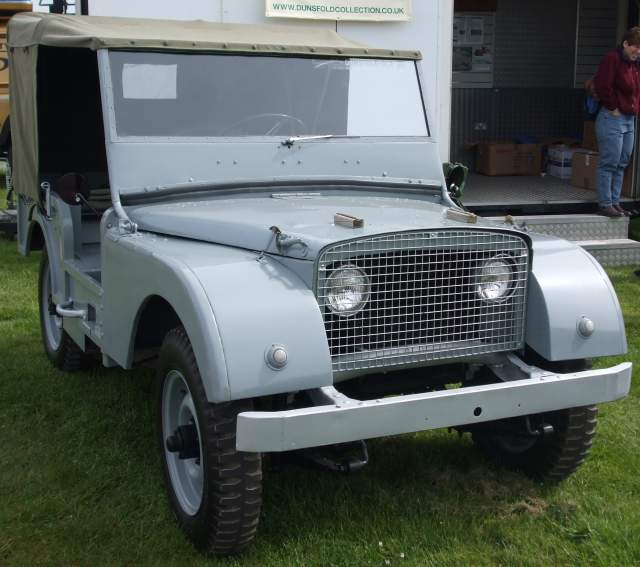
The British Army wanted to introduce common mechanical parts across its military vehicles and commissioned 33 prototype Land Rover 80" series I's fitted with the Rolls Royce B40 engine, as used in the Austin Champ. The Rolls Royce B40 engine was larger than Land Rover's own 1.6 litre unit and this meant the radiator had to be moved forwards and the bonnet raised slightly at its leading edge. The wheelbase was also adjusted slightly to 81 inches. The B40 Land Rover was allegedly a very accomplished machine, and very quick, however the experiment was too costly and simpler military adaptations of the standard civilian Land Rover proved much more successful in the long run.

Land Rover B40 prototype - pic © L. Allison
1962: The 129" Truck Project
There were five prototypes built for military trials for the Belgian Army in the early sixties. Dunsfold and Gaydon each have a 129" truck prototype. This design has a 129" wheelbase, 9.00x16 or 11.00x16 tyres, and 2.5 litre 4-cylinder turbo-diesel (with a 5 main bearing crank and a CAV turbo and intercooler, Land Rover's first try at a turbo-diesel engine), or 2.6 litre 6 cylinder petrol. The 129" has the leaf springs over the axles, and the load capacity is 35cwt. A four-speed 'crash' (no synchromesh) gearbox with a much larger oil capacity is coupled up to a special remote transfer box with a tyre inflation set up. Most of the cab section derives from the ordinary Land Rover of the day.


Two of the Land Rover 129 inch truck prototypes
1963: 'Two Tonne' Forward Control Truck Project
This project was short lived indeed, another push at 'bigger' Land Rovers. It was at the request of the MoD that Land Rover developed this 'two tonne' forward control model at the end of 1963. It had a 24 volt electrical system, and was equipped with the most powerful petrol engine Rover had at the time, the 3 litre, six cylinder engine from the Rover P5. The MoD wanted a diesel version, and an agreement with Perkins gave Land Rover access to the Perkins 5.8 litre, 6 cylinder engine. The vehicle was equipped with a five speed gearbox, made by Turners of Wolverhampton, coupled to a transfer box manufactured by All Wheel Drive.

Land Rover FC 'two tonne' truck prototype

Land Rover FC 'two tonne' truck prototype
At the beginning, the MoD wanted a large vehicle, and so the wheelbase was set at 129 inches. But as testing progressed, the wheelbase was changed to 120 inches and then to 112 inches. Despite Land Rover's best efforts, the MoD finally decided not to make an order for these vehicles. Another prototype was built, this vehicle being adapted as a transporter for the Rover-BRM Gas Turbine Racing Car. This machine was front wheel drive, utilising a similar drivetrain to ‘Buttercup’ but only using the front drive output from the transfer box. The rear bed of the truck raised and lowered utilising hydraulic rams to allow the vehicles to be loaded and unloaded. Buttercup was kept by Land Rover and used as a recovery truck and general runabout. An attempt was also made to prepare the vehicle for the civilian market, but development problems with the Perkins engine meant the project could not continue.

'Buttercup' Land Rover FC 'two tonne' truck prototype.

'Buttercup' at the Dunsfold show 2009.
1965:The "Big Lightweight" 3/4 ton gun tractor.
Also known as the 110" Bonneted Control Land Rover, the 3/4 ton was a private venture by Land Rover to produce a 'lightweight' type vehicle designed for pulling power-driven trailers and the British Army's 105mm gun. It was similar in style to the 1/2 ton and used some components from it. It was powered by the Rover P5 3.0 litre 6 cylinder petrol engine, producing 110bhp. The vehicle was fitted with one-ton spec. Dunlop Track grip 9.00x16 tyres. The wheelbase was 110", with a second transfer box to drive the trailer/gun axle, allowing 2,4,or 6 wheel drive. It's thought that development problems with this drive system were the cause of the project's demise. It only reached prototype stage in 1965 with just 3 being produced. Two are thought to still exist, and one of these is in the Dunsfold Collection.
The theme was picked up again with the development of the 101" forward control vehicle, the one tonne.

3/4 ton 'Big Lightweight'.
1976-1986: The Land Rover 100" Prototypes
1976: The prototype 100" (wheelbase) Land Rover was originally built on a Range Rover chassis, and so became the first coil-sprung 'Land Rover'. The inner front wings were cut to make place for the suspension turrets. The front of the vehicle is Stage 1, which was not yet in production. Over a number of years, Land-Rover experimented with different wheelbases and spring configurations. Land Rover set up a development team to set up a short and a long wheelbase version of this vehicle, i.e. a 90 and a 110. However money being tight, the project was hampered until the Swiss Army showed an interest in the existing 100" version. The 100" was being developed mainly towards military sales, and so were actively promoted around 1978/9 to the Swiss and French military. In 1978 a fleet of 15 vehicles was built for the Swiss. They were constructed from a collection of parts from Series III, Stage 1's, 110's and Range Rovers. It is believed that they covered every combination of left-and right-hand steering, engines etc. In the end both countries bought other products. The project continued, and over time went through at least 70 experimental versions. Various body styles and engine configurations were experimented with, from 2.25 litre Diesel Soft Tops to 3.5 litre V8 Station Wagons. The project was ended with the release of the '90', and many of the prototypes were destroyed or sold on to Land Rover employees.

Land Rover 100 inch prototype.

1979 Land Rover 100 inch prototype.
1986: The Llama Project
The Llama is another interesting prototype, and quite possibly the best one they never made. Designed and developed in the mid 1980s as the successor to the 101 Forward Control, a number were built for evaluation by the Ministry of Defence. The Llama used the chassis and many parts from the relatively new 110, so was permanent 4x4, and was fitted with the 3.5 litre Rover V8. The 2.5 Litre Turbodiesel engine was also tested. The vehicle was fitted with a Santana LT 85 gearbox, and power steering. It had wider than standard axles, however. The Llama also had a very modern tilt-forward fibreglass cab (to reduce weight), instead of the aluminium box cab of the 101. Ten prototypes and two pre-production vehicles were built. However, the project was cancelled, (the MoD having chosen the Pinzgauer as the 101 fc's replacement) and only a few remain, with one on display at the Heritage Centre.

Land Rover Llama prototype.
1991: The 'Juno' prototype
This is the last surviving prototype of the Land Rover 'Challenger' project from the early 1990's. (three vehicles were built, but the others were crushed) The Challenger project was initiated due to increased competition in the military supply sector from foreign manufacturers. Ever since the Series I, Land Rovers had served the military in almost every country in the world. But as the Defender design became older and more expensive, more and more governments started to look elsewhere for their defence vehicles. A quality replacement was needed for the Defender, and so a new vehicle had to be developed.
The 'Juno' is based on a series I Discovery platform. The chassis is slightly longer at 115" wheelbase. The interior is straight out of a Series I Discovery, with just an additional binnacle on the Dashboard for extra switches and instruments. The power plant is a heavily modified 200 Tdi unit, itself a prototype of the 300tdi. It employs a Range Rover automatic gearbox.
Eventually, although it was a very capable vehicle, it was not thought to be versatile enough for general military use. However, the research undertaken during the 'Challenger' project was used in project 'Wolf' to develop the Defender XD. The prototype shown below is now owned by the Dunsfold Collection.


Pictures above © www.difflock.com
1997: Land Rover LCV (Lightweight Concept Vehicle) project
Faced with ever-rising fuel prices and more stringent total vehicle emissions legislation, Land Rover initiated a programme of work in the early 1990s to investigate lightweight technologies for their production 4x4 vehicles. The Lightweight Concept Vehicle (LCV) programme planned to investigate and develop new technologies, culminating in a vehicle that would enhance Land Rover’s off-road ability and achieve a combined fuel economy of 40mpg.
The first vehicle in the programme, code-named LCV 1, was based on a series I Discovery. The vehicle weight was reduced by replacing the steel chassis and body panels with aluminium replicas. This produced encouraging results, but showed that an all-aluminium vehicle required specialist design. The second step, LCV 2, produced several prototypes based around the appearance of a Defender 90 station wagon. Through the design of a unique bonded and riveted space frame, the strength and durability of the aluminium vehicle was comparable to that of a production Defender. This design approach resulted in a significant reduction in the overall vehicle weight (379 kilograms), giving a much improved fuel economy and increased performance with no loss of off-road ability.

LCV 2/3.

LCV 2/3.

LCV 2/3.
The final vehicle to be manufactured in the programme, the LCV 2/3, further developed the lightweight technologies to investigate their benefit on vehicle performance. The LCV2/3 was built as a 'taster' of what was planned for the LCV 3 project, which never got underway. The space frame design philosophy and construction techniques were essentially the same as those employed for LCV 2. The upper structure, however, was redesigned to accommodate the change of body from station wagon to pick-up and the development of the style to improve overall vehicle aerodynamics. A fully revised cab interior also brought the vehicle up to date. The vehicle was fitted with an aluminium 2.5 litre 174bhp V6 petrol engine (KV6) to improve the vehicle’s performance. There were many reasons why this project stopped. The cost of repairs to damaged vehicles built in this fashion, and the associated investment required in main dealer facilities were but two.
2003: The Range Stormer Concept Vehicle
The Range Stormer Concept vehicle was Land Rover's public introduction of the idea of a 'smaller' and 'sportier' Range Rover product. The concept came to fruition in the form of the Range Rover Sport, which is aimed at the "sports car 4x4s" such as the BMW X5, Mercedes ML, VW Touareg and Porsche Cayenne, with the idea of equalling their on-road performance while retaining the legendary Range Rover off-road capability. The outward design was diluted a little on the Sport, but it has proved to be a favourite with buyers.

Range Stormer Concept vehicle.
The 106" Discovery Project
In the early 1990's this prototype was produced, which gives extra space in the rear passenger compartment. From the grainy picture below, you may just be able to discern the extra panel and window between the doors. If you have more on this prototype, please e-mail us.

Land Rover Discovery 106 inch prototype.
Built for the CEO of British Aerospace in 1994, this vehicle has been adapted with a 'filler' panel between the front and rear doors. This, we believe, is exactly the same as was done on the 106" prototype of just a few years previously.


Land Rover Discovery 106 inch.
2008: The LRX Concept Vehicle
The LRX Concept vehicle was Land Rover's took over from the Range Stormer project in pushing the Idea of a smaller, greener 4x4 Range Rover. Now officially passed for production as the new 'baby' Range Rover, this concept will provide the benchmark at the luxury end of the 'crossover' 4x4 market. Typical competitors will be the BMW X3, Toyota RAV4 and Mitsubishi Outlander.

LRX Concept vehicle.
If you can help us out with more information Land Rover prototypes (even ones we haven't mentioned!), please do so. You can contact us at admin@lr-mad.co.uk.
More prototype pictures

An early 101 FC Prototype.

The Land-e.