Military Land Rovers guide: ex army models from the Series I to the Wolf
On 2 May 1949 the War Department signed its first volume contract for the Land Rover: 1,878 vehicles, barely a year after the 80-inch prototype appeared at the Amsterdam Motor Show. That order opened a supply relationship that ran for more than seven decades, put six-figure numbers of green Solihull 4x4s into British service, and spread licence-built cousins from Belgium to Australia. This military Land Rover guide covers the full story: how the Army adopted the Land Rover, which models served and in what numbers, the strange one-off conversions, and what buying an ex army Land Rover involves today, from MoD disposal sales to DVLA paperwork.
From the Series I to the Wolf: how the British Army adopted the Land Rover
Rover unveiled the Land Rover on 30 April 1948. Within weeks, two pre-production demonstrators went to the Ministry of Supply for evaluation at the Fighting Vehicle Development Establishment in Chertsey, Surrey. The trials went well. A pilot order for 20 vehicles followed, then the 1,878-vehicle contract of May 1949, with the first vehicle completed at Solihull on 8 July 1949 and taken into service at Feltham ten days later.
The timing was awkward for the War Office, which had already commissioned a purpose-designed quarter-ton 4x4, the Austin Champ. The Champ was sophisticated and expensive; the Land Rover was a lightly adapted farm vehicle that cost less, weighed less and burned less fuel. Both served through the 1950s, but the cheaper truck won the argument. By 1958 the Ministry of Supply had placed 40 separate contracts and taken delivery of around 13,500 Series I Land Rovers across the 80, 86, 88, 107 and 109-inch variants, and the Champ was on its way out.
From that point the pattern held for two generations of soldiers. The Series II arrived in 1958 and the Series IIa in 1961, standardised as the Truck Utility in short and long wheelbase forms. The 1960s and 1970s brought the specialised offshoots described below: the air-portable Lightweight of 1968, the V8-engined 101 Forward Control gun tractor of 1975, and armoured conversions for Northern Ireland. Coil-sprung One Ten and Ninety models followed the civilian range into uniform during the mid-1980s.
The last great order came in January 1996, when the Ministry of Defence announced the purchase of roughly 8,000 examples of a heavily re-engineered Defender known inside Land Rover as the XD and to the Army as the Wolf, a contract worth close to £170 million. Those trucks are still working. In 2025 more than 5,000 Land Rovers remained across the UK armed forces, and only in March 2026 did the government confirm the fleet would finally be retired, with a new generation of light mobility vehicles due with soldiers by 2030 and a £71 million life-extension contract awarded to NP Aerospace in September 2024 to keep the armoured types serviceable until then.
The models in service
Hundreds of variants existed once radio fits, hard tops and role kits are counted, but five families dominate the military story. Fuller profiles of each live in the vehicle registry.
Lightweight (Air-portable)
The half-ton Lightweight answered a 1960s requirement for a Land Rover that could travel two-abreast inside an Argosy transport aircraft and swing beneath a Wessex helicopter. Rover’s solution was a narrowed 88-inch Series IIa with demountable panels: doors, windscreen, tilt and upper body panels came off to shed weight for the flight and bolted back on at the other end. The joke among enthusiasts is that a fully dressed Lightweight actually weighed more than the standard 88 it replaced, because of all the brackets that made the stripping possible.
Quantity production began on 11 November 1968, and 2,989 Series IIa Lightweights were built before the Series III version took over in 1972. Another 12,334 Series III examples followed up to 1980; records after that are patchy, but roughly 18,000 are reckoned to have been built by the time production ended in the mid-1980s. Belgium, the Netherlands, Brunei and Jamaica were among the export customers. The full story, including the anti-tank and deep-wading versions, is in the Lightweight profile.
101 Forward Control
The 101 Forward Control was built to tow the L118 light gun with a tonne of ammunition on board, which earned it the official name One Tonne. Land Rover gave it the Range Rover’s 3.5-litre V8 and LT95 gearbox on a purpose-built 101-inch chassis with the cab perched above the front axle. Production for the MoD ran from 1975 to 1978 and totalled 2,669 vehicles, in left and right-hand drive and 12-volt and 24-volt forms. Marshall of Cambridge bodied ambulance and radio variants, including the odd Vampire radio-direction-finding version.
The 101 had forerunners in the same layout: the civilian Series IIa Forward Control of 1962 (fewer than 2,500 built) and the improved IIb of 1966 to 1972 (2,305 built). Both are covered in the Forward Control profile.
Wolf / Defender XD
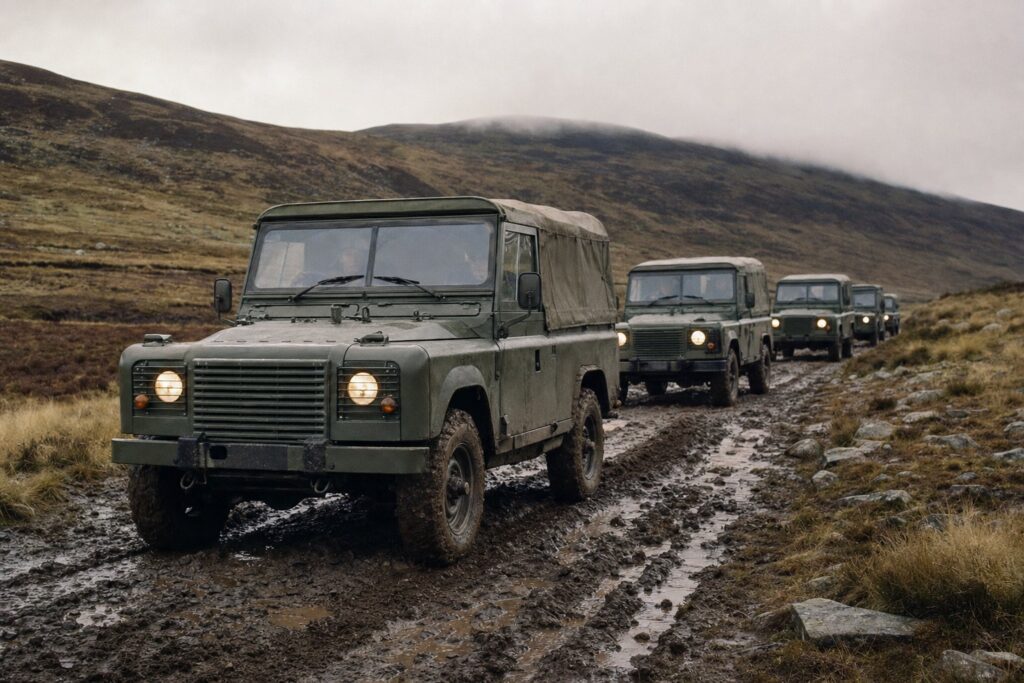
The Land Rover Wolf is the vehicle most people picture when they hear the phrase military Land Rover. Ordered in January 1996 after competitive trials, the XD (eXtra Duty) programme delivered 1,411 Defender XD 90s designated Truck Utility Light (TUL) HS and 6,514 Defender XD 110s designated Truck Utility Medium (TUM) HS, plus around 800 XD 130 ambulances bodied by Marshall. HS stands for high specification. Under the familiar shape sat a strengthened chassis, uprated axles and a militarised 300Tdi diesel; it looks like a civilian Defender but shares surprisingly little with one.
Wolf remains the backbone of the residual fleet, which is why genuine examples command the strongest prices on the surplus market. Civilian-specification 90s and 110s bought by the MoD alongside the Wolf fleet are often confused with it, and the difference matters to a buyer, as covered below.
Perentie (Australia)
Australia ran its own programme. The Perentie, built by JRA Limited at Moorebank, New South Wales, from 1987, took the 110 shell and re-engineered it around an Isuzu 3.9-litre four-cylinder diesel and a galvanised chassis. Initial orders covered 2,500 4x4s and 400 of the remarkable 6x6 variant, and the fleet had grown to nearly 4,000 vehicles by the early 1990s. Published production figures for the 6x6 vary widely between sources, from around 400 up to 970 once later batches are counted, so treat any single number with caution. The Special Air Service Regiment’s Long Range Patrol Vehicle was a 6x6 Perentie derivative. See the Perentie profile for the variant-by-variant breakdown.
Other notable types
Beyond the big five, the military family tree branches quickly. The One Ton 109 of 1968 was an uprated six-cylinder Series IIa/III for gun-towing duties, and is routinely confused with the One Tonne 101; they are entirely different vehicles. Belgium’s Minerva built steel-bodied Series Land Rovers under licence from 1952 for the Belgian army, Spain’s Santana developed its own military 88 and 109 models in Linares, and Turkey’s Otokar took a Defender licence in 1987 that grew into a line of armoured derivatives. Each licence story is told in the registry.
| Model | Service era | Number built / delivered | Claim to fame |
|---|---|---|---|
| Series I (military) | 1949 onwards | ~13,500 by 1958 | First contract: 1,878 vehicles, May 1949 |
| Lightweight | 1968–1990s | ~18,000 | Air-portable, demountable panels |
| Series IIa/IIb Forward Control | 1962–1972 (production) | ~4,800 combined | Cab-over load carrier |
| 101 Forward Control | 1975 onwards | 2,669 | V8 gun tractor, the “One Tonne” |
| Wolf / Defender XD | 1996 onwards | ~8,000 ordered | 1,411 TUL + 6,514 TUM + ~800 ambulances |
| Perentie | 1987 onwards (Australia) | ~4,000 fleet | Isuzu diesel, galvanised chassis, 6x6 option |
The specials: armoured, tracked and amphibious
The standard trucks tell only half the story. Ulster produced the armoured line: the Shorland armoured patrol car, built by Short Brothers and Harland in Belfast on a strengthened Series IIa chassis, entered Royal Ulster Constabulary service on 30 March 1966 and passed to the Ulster Defence Regiment in 1970. Its distant successor was the Snatch, an NP Aerospace composite-armoured Defender 110 of which nearly 1,000 were built, first for Northern Ireland and later, controversially, for Iraq and Afghanistan. The whole lineage, from Shorland to Simba to Tangi, is traced in the armoured Land Rovers profile.
Scotland contributed the strangest conversion of all. James A Cuthbertson Ltd of Biggar mounted Land Rovers on four rubber tracks from around 1958, dropping ground pressure to under 2 psi for bog and snow work; only about 15 are believed to have been made, though some accounts say fewer than 20. The Cuthbertson profile covers the survivors. And in 1963–64 Rover built a batch of amphibious Air Portable General Purpose (APGP) 109s with exhaust-inflated flotation bags and a propeller on the rear propshaft; quoted build figures range from about 26 to 50, and the type never entered service. The amphibious profile follows the swimming Land Rover idea through to its later revivals.
Buying an ex army Land Rover: a practical guide
Demobbed Land Rovers have been reaching civilian hands since the 1950s, and the current fleet drawdown means the flow of ex army Land Rovers for sale is stronger now than at any point since the Wolf arrived. Prices run from project-grade Series and Lightweight trucks at scrap-plus money to five-figure sums for a clean, low-mileage Wolf 110 with full documentation.
Where the vehicles come from
Nearly everything starts with the Ministry of Defence disposal programme. Witham Specialist Vehicles Ltd holds the MoD contract for marketing and selling surplus vehicles, and lists retired stock through direct sales, tenders and timed online auctions on its mod-sales.com site; the current Land Rover retirement is being handled the same way. Independent dealers buy in bulk from those disposals and retail the vehicles on. L Jackson & Co, trading from Misterton in Nottinghamshire since 1950, is one of the longest-established, with a yard that runs to thousands of items of MoD surplus military vehicles and equipment. Private sellers and smaller traders advertise through Milweb, the long-running military-vehicle classifieds site, and through the usual auction houses and enthusiast clubs.
Buying at disposal auction is the cheap route but the least protected: vehicles are sold as seen, often unregistered, sometimes without keys or batteries, and collection deadlines are short. A dealer charges more for the same truck but will usually have registered it, serviced it and sorted the paperwork. Used ex military Land Rovers also circulate between enthusiasts, where a documented history matters more than a fresh coat of NATO green.
What to check before you pay
Military service is hard on a vehicle in specific ways, so an inspection should concentrate on a handful of points.
- Chassis and bulkhead. The classic Land Rover weak points apply double to trucks that sat in vehicle parks for years. Check rear crossmember, outriggers, spring hangers and bulkhead footwells for rot and fresh underseal hiding it. A Wolf’s strengthened chassis resists better but is not immune.
- Genuine Wolf or look-alike. A true Wolf XD has its own chassis number sequence, heavier axles and detail differences throughout. Civilian-spec ex-MoD Defenders are honest trucks but worth less, so verify identity against the documentation rather than the paint.
- 24-volt electrics. FFR (Fitted For Radio) vehicles carry 24-volt systems, generator panels and radio tables. Parts exist, but accessories, bulbs and diagnosis all get harder; a 12-volt GS (General Service) truck is the easier daily proposition.
- Service record. Ask for the military record card and MoD release paperwork. A truck with documented in-service history is worth a premium and is far easier to register.
- Mechanical honesty. Low recorded mileage can mean years of idleness rather than gentle use. Perished seals, seized brake components and stale fuel systems are more common than worn engines.
Registration, tax and the DVLA
Most vehicles leave MoD service unregistered, so the buyer makes a first registration using DVLA form V55/5. The application needs evidence of the vehicle’s age and identity: MoD documentation usually suffices, and where it is missing, a dating letter from a DVLA-recognised club such as the Invicta Military-Vehicle Preservation Society fills the gap. Vehicles registered this way receive an age-related number plate appropriate to their year of build.
Two age thresholds matter financially. A vehicle built more than 40 years ago qualifies for the historic vehicle tax class, which carries a zero rate, though the owner must apply for the status rather than receiving it automatically, and must still renew the (free) tax each year. The same rolling 40-year point brings MOT exemption, provided the vehicle has not been substantially changed and the owner makes the declaration when taxing it. Anything younger, including every Wolf for some years yet, needs a normal MOT, and ex-military quirks such as missing seatbelts or masked lighting must be brought up to road standard first. Standard car insurance categories apply, though specialist military-vehicle policies usually price these trucks more sympathetically.
Military Land Rovers in numbers
The production and fleet figures from the sections above, gathered in one place.

Reuse this chart with attribution:
<a href="https://www.lr-mad.co.uk/military-land-rovers/"><img src="https://www.lr-mad.co.uk/wp-content/uploads/infographics/military-land-rovers-in-numbers.svg" alt="Military Land Rovers in numbers" width="800"></a>Frequently asked questions
What is a military Land Rover?
A Land Rover built or modified to a defence contract rather than civilian specification. That covers everything from the 1949 Series I contracts through the air-portable Lightweight and the 101 Forward Control to the Defender-based Wolf of 1996, plus armoured and licence-built derivatives made overseas.
What is a Land Rover Wolf?
The Wolf is the British Army’s name for the Defender XD, a heavily re-engineered Defender ordered in January 1996. Around 8,000 were bought: 1,411 XD 90s (TUL HS), 6,514 XD 110s (TUM HS) and roughly 800 XD 130 ambulances. It has a strengthened chassis and uprated drivetrain and shares far less with the civilian Defender than it appears to.
How many Land Rovers has the British Army operated?
No single official total exists, but the scale is clear from the contracts: about 13,500 Series I vehicles by 1958, roughly 18,000 Lightweights, 2,669 101 Forward Controls and some 8,000 Wolfs, plus tens of thousands of standard Series and Defender types in between. More than 5,000 were still in UK service in 2025.
Where can I buy an ex-army Land Rover in the UK?
The main sources are the MoD disposal sales run by Witham Specialist Vehicles (mod-sales.com), established surplus dealers such as L Jackson & Co in Nottinghamshire, and the Milweb classifieds for private and trade sales. Enthusiast club noticeboards and general auction houses carry the older collectable types.
How much does an ex-military Land Rover cost?
Condition and provenance set the price more than age. Rough auction-grade Defenders start at a few thousand pounds, tidy GS trucks sit in the mid single-figure thousands, and a documented, low-mileage Wolf 110 can reach five figures. Rare types such as the 101 Forward Control and clean Lightweights trade as collector vehicles.
Are ex-military Land Rovers road legal?
Yes, once properly registered and brought up to road standard. Most leave service unregistered, so the buyer completes a DVLA first registration, fits any missing road equipment, and arranges an MOT where the vehicle’s age requires one. Thousands are on UK roads already.
Do I need a special licence to drive one?
No. The utility Land Rovers, including the Wolf, 101 and Lightweight, sit within the weight range of an ordinary category B car licence. Only if you tow heavy trailers or move into larger surplus trucks do additional categories come into play.
How do I register an ex-MoD Land Rover with the DVLA?
Apply for first registration on form V55/5 with proof of the vehicle’s age and identity, typically the MoD release paperwork or military record card. If that documentation is missing, a dating letter from a DVLA-recognised club such as the Invicta Military-Vehicle Preservation Society is accepted. The vehicle then receives an age-related registration number.
Is an ex-army Land Rover tax exempt?
It can be. Vehicles built more than 40 years ago qualify for the historic vehicle tax class at a zero rate under the rolling exemption. The owner must apply for historic status and still renew the free tax annually. Newer vehicles, including all Wolfs for now, pay normal vehicle tax.
Do ex-military Land Rovers need an MOT?
Vehicles over 40 years old are MOT exempt if they have not been substantially changed, with the owner making a declaration to that effect. Younger vehicles need a standard MOT, and a freshly demobbed truck often needs lighting, seatbelt and tyre attention before it will pass.
What do FFR and GS mean?
GS stands for General Service, the standard 12-volt utility vehicle. FFR means Fitted For Radio: a 24-volt system with a larger generator, screened electrics and radio equipment mounts. FFR trucks are historically interesting but slightly harder to live with, since 24-volt accessories and spares take more finding.
What should I inspect before buying an ex-army Land Rover?
Chassis and bulkhead corrosion first, especially the rear crossmember and outriggers. Then identity: confirm a claimed Wolf against its chassis number and paperwork. Check for storage-related faults such as perished seals and seized brakes, and ask for the military record card, which supports both value and registration.
Can I import a Land Rover Perentie to the UK?
Yes. Australian disposals released thousands of Perenties to the public, and right-hand drive makes them straightforward UK imports, subject to shipping costs, import duty and VAT, and the usual DVLA registration process with proof of age. Their Isuzu diesel is well supported, though some parts must come from Australia.
What replaced the Land Rover in the British Army?
A direct successor has not yet been fielded. The government confirmed in March 2026 that the fleet will retire, with a new family of light mobility vehicles due by 2030; NP Aerospace received a £71 million contract in 2024 to keep the existing armoured fleet serviceable until then. Candidates for the replacement are still being trialled.
Can civilians buy a Snatch Land Rover?
Yes, demilitarised examples appear at disposal sales and with dealers from time to time. The composite-armoured body makes them heavy, thirsty and slow, so most go to collectors and film work rather than daily use. Nearly 1,000 were built, so they surface regularly.
What is the difference between the One Ton and the One Tonne?
Two different vehicles with confusingly similar names. The One Ton is an uprated six-cylinder 109-inch Series IIa/III load carrier introduced in 1968. The One Tonne is the official name of the V8-engined 101 Forward Control gun tractor of 1975. Sellers mix them up often enough that the distinction is worth knowing.
Are military Land Rovers a good investment?
The rare types have appreciated: 101s, Lightweights and early Series military vehicles with history all trade above equivalent civilian trucks. The current mass disposal of Defenders and Wolfs is holding those prices in check, so buyers today are better placed than sellers. Condition and paperwork drive value far more than rarity claims.
In summary
The military Land Rover story runs in an unbroken line from the 1,878-vehicle War Department contract of May 1949 to the 5,000-plus trucks still serving as the fleet winds down towards its 2030 replacement. Along the way came the stripped-down Lightweight, the V8 101 gun tractor, armoured Shorlands and Snatches, tracked and amphibious experiments, and full re-engineerings abroad in the shape of the Perentie. For the timeline of the marque behind this military Land Rover guide, see the Land Rover history page. And for anyone tempted by the ex army surplus market, the mechanics are simple: buy on condition and paperwork, understand what the FFR wiring and Wolf badging really mean, and budget for the V55/5 registration process before the first green lane beckons.