The Cuthbertson Land Rover: the Scottish Tracked Conversion
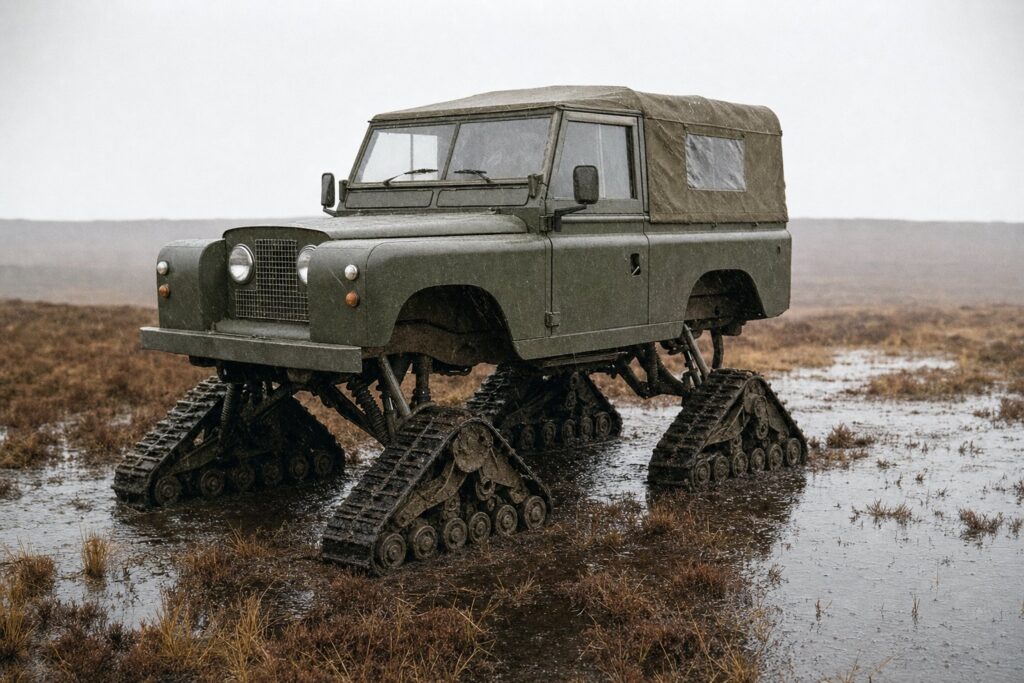
- Years
- 1958 – early 1970s
- Engine
- Donor Land Rover units; 2,286 cc petrol on the surviving Series II 109"
- Drive
- Full-tracked — four sprocket-driven rubber tracks on a bolt-on subframe
- Built
- Estimated 15–20 conversions
- Origin
- Biggar, Lanarkshire, Scotland
In 1958 a firm of agricultural engineers in Biggar, Lanarkshire, took a new Land Rover Series II, removed its road wheels and lowered the whole vehicle onto four rubber tracks. The Cuthbertson tracked Land Rover, as the conversion became known, could cross bog, snowfield and tidal marsh that would swallow a wheeled 4x4 to its axles. Fewer than twenty were ever built. The handful that survive now rank among the most collectable Series Land Rovers of any description, and a restored example has changed hands at a major British auction house within the last decade.
This profile covers the company behind the conversion, the engineering of the track system, the specification of the Series II version, the work these machines actually did in civilian and military hands, and what the survivors are worth today.
James A. Cuthbertson Ltd: the Biggar firm behind the tracks
James Archibald Cuthbertson began trading as an agricultural engineer in Biggar, Lanarkshire, in 1936, and the business was incorporated as James A. Cuthbertson Ltd in 1946. Snowploughs have been designed and built in the town since the company’s earliest years, and the ferocious winter of 1947 cemented the firm’s local reputation when its ploughs helped dig the surrounding district out of record drifts.
Snow clearance was only half the story. Cuthbertson was an early manufacturer of rubber tracks, with development work reaching back to the Second World War, and the company is credited with designing the first endless rubber belt. That expertise fed a whole family of soft-ground machines: half-track conversions, the Water Buffalo tracked tractor built for forestry work on ground too wet for wheels, and, from 1958, the tracked Land Rover conversion this page is about. Readers interested in other attempts to take the marque beyond dry land will find the amphibious Land Rovers profile a natural companion piece.
The company never became a vehicle manufacturer in its own right, and never needed to. Its tracked Land Rover was a conversion in the purest sense: a standard Solihull product adapted in Scotland for a job the factory never envisaged. James A. Cuthbertson Ltd still trades from Biggar today, specialising in winter maintenance equipment, principally snowploughs, snowblowers and gritting spreaders for local authorities and contractors.
How the Cuthbertson tracked conversion works
The Cuthbertson tracked conversion is conceptually simple and mechanically clever, which is probably why it worked where more elaborate schemes failed.
The subframe and the four bogies
Cuthbertson fabricated a substantial subframe carrying four triangular track bogies, one at each corner, positioned to line up with the donor vehicle’s axles. A standard Land Rover, minus its wheels, was lowered onto this subframe and bolted down. In place of each road wheel went a wheel-sized steel sprocket, which drives a rubber track around a set of smaller rubber-tyred wheels at the base of each bogie unit. Because the bogies and subframe carry the vehicle’s weight, the standard axles, springs and hubs are relieved of much of the punishment they would otherwise take on rough ground.
The arrangement kept the donor vehicle remarkably intact. Engine, gearbox, transfer box and axles all remain standard Land Rover, and drive reaches the tracks through the normal four-wheel-drive transmission: each sprocket simply turns where a wheel used to.
Steering a tracked Land Rover
Steering is the clever part. Rather than skid-steering like a tank, braking one side to slew the vehicle round, the two front bogies pivot as complete units, so a Cuthbertson steers much as a wheeled Land Rover does. Swinging entire track assemblies through a turn takes real muscle, and Cuthbertson answered that with a power steering system driven from the engine’s crankshaft pulley, decades before power assistance appeared on any production Land Rover.
What the tracks give, and what they take away
- Ground pressure collapses. On tracks the vehicle exerts roughly 1.9 lb per square inch, a figure that let it cross snow, peat bog and soft marsh that no wheeled vehicle of the period could attempt.
- Clearance rises. The bogies lift the body well clear of ruts and surface water, though the vehicle stands far taller than a standard Series II as a result.
- Road manners suffer. The tracks are noisy on tarmac and around 20 mph was considered a good speed on a sealed surface. These were never highway vehicles.
- Steps and banks are the weak point. The track run sits low and flat, without the raked climbing face of a military tank track, so a rock ledge or ditch bank that a tank would ramp over can stop a Cuthbertson dead.
- The tracks are demountable in theory. The conversion was designed so the vehicle could return to wheels, though period observers noted drily that carrying the removed track gear more or less required a second vehicle.
The 1958 Land Rover Series II Cuthbertson in detail
Cuthbertson’s earliest track work involved Series I donors, but 1958, the launch year of the Series II, is when the conversion is generally reckoned to have entered proper production, and the 1958 Land Rover Series II Cuthbertson is the version collectors and historians know best. Conversions were carried out on both short and long wheelbases, and photographs of Series III examples confirm the work continued into the early 1970s. Where the tracked Land Rover fits within the model’s wider timeline is covered in the site’s Land Rover history feature.
The best-documented survivor is a 1958 Land Rover Series II 109" Cuthbertson tracked utility vehicle, chassis number 151900157, completed at Solihull on 8 September 1958 and fitted with its tracks when new. Its recorded specification is the closest thing to a factory data sheet the type has.

Reuse this graphic with attribution:
<a href="https://www.lr-mad.co.uk/vehicles/cuthbertson-tracked/"><img src="https://www.lr-mad.co.uk/wp-content/uploads/infographics/cuthbertson-tracked-numbers.svg" alt="Cuthbertson tracked Land Rover figures" width="800"></a>| Specification | 1958 Land Rover Series II 109" Cuthbertson |
|---|---|
| Base vehicle | Land Rover Series II, 109 in wheelbase |
| Engine | 2,286 cc four-cylinder petrol |
| Power | 68 bhp at 4,250 rpm |
| Torque | 116 lb ft at 2,500 rpm |
| Transmission | Four-speed manual, four-wheel drive |
| Steering | Front bogies pivot as units; engine-driven power assistance |
| Running gear | Four sprocket-driven rubber tracks on a bolt-on subframe |
| Ground pressure | Approximately 1.9 psi (about 13 kPa) |
| Practical top speed | Around 20 mph |
| Production | Estimated 15 to 20 conversions, from 1958 |
Two numbers in that table deserve a second look. The first is the ground pressure: 1.9 psi from a vehicle carrying a full steel body, chassis and drivetrain is an extraordinary figure, and it is the entire reason the conversion existed. The second is the power output. Sixty-eight brake horsepower had to turn four tracks through mud, so nobody bought a Cuthbertson for pace; they bought it because it kept moving when everything else had sunk.
No reliable kerb weight for the converted vehicle appears in the auction records or period coverage, so this profile does not quote one. The subframe, bogies and tracks clearly added a great deal of mass over the standard 109’s figure, which the modest top speed reflects.
What Cuthbertson Land Rovers were used for
Forestry, moor and marsh
The conversion was created for boggy Scottish forestry ground, and land work of that kind remained its core trade: plantation forestry on peat, hill farming on waterlogged ground, drainage and estate work in places a tractor would ruin or a wheeled Land Rover simply could not reach. The low ground pressure had a side benefit that reads surprisingly modern: a machine that floats over soft ground rather than cutting into it does far less damage to the land it crosses.
Utility and recovery work
Telecommunications and other utility operators used tracked Cuthbertsons to maintain lines and equipment strung across moorland, and the type also found work in vehicle recovery, hauling bogged machinery off ground that had already claimed one victim. A Series III example in utility service was still being photographed at work in Scotland well into the 1980s.
Military service: mine clearance and RAF bomb disposal
The military valued exactly the same quality that foresters did, for a rather more delicate reason: a vehicle spreading its weight over a large area is a useful thing to drive across ground that may contain unexploded ordnance. Cuthbertson Land Rovers served with Royal Air Force bomb disposal units in the early 1960s, chiefly employed as mine clearing vehicles on coastal ranges, where period accounts describe them slogging through mud and wading dykes five feet deep. Early service crews needed an ‘A’ class licence covering track-laying vehicles before they were allowed behind the wheel. The tracked Cuthbertson sits within a long tradition of the marque in uniform, which the site’s military Land Rovers hub traces from the Minerva to the Wolf.
The Australian Army trial
Interest was not confined to Britain. The Registry of Ex-Military Land Rovers records that the Australian Army took a Cuthbertson conversion on evaluation, running it through more than 600 miles of trials. No Australian fleet of tracked Land Rovers followed, and Australia’s military would eventually commission its own heavily re-engineered Land Rovers in the form of the Perentie programme two decades later.
Survivors, auctions and collectability
With production estimated at 15 to 20 vehicles and a working life spent in bogs, survival was always going to be the exception. The known survivors can be counted on one hand.
Where the survivors are
- British Motor Museum, Gaydon. A Cuthbertson tracked Land Rover forms part of the national collection in Warwickshire, and it is the example most enthusiasts will actually get to stand next to.
- Lix Toll, Perthshire. A 1962 example has long been associated with the well-known Land Rover specialist garage at Lix Toll near Killin, and has been photographed there repeatedly by enthusiasts.
- The restored 1958 109" (registration 178 UYU). Chassis 151900157, the auction car described above, restored around 2000 and described at its 2017 sale as believed to be the only Cuthbertson Land Rover then in the UK, the others having spent years abroad or in museum hands.
Cuthbertson Land Rover auction results
The paper trail on values is thin but unusually clean, because one vehicle has done most of the selling. The restored 1958 car spent time in a Norwegian collection, was sold on in 2011, then passed through German ownership until 2015 before returning to Britain. Bonhams offered it at the Goodwood Revival sale on 9 September 2017 with an estimate of £50,000 to £60,000; it sold for £33,000 including premium. Within months a UK dealer was advertising the same vehicle at £59,995, a listing that earned it a fresh round of national coverage during the snowbound spring of 2018.
| Year | Event | Figure |
|---|---|---|
| 2011 | Sold from a Norwegian private collection | Price not published |
| 2017 | Bonhams, Goodwood Revival (estimate £50,000–£60,000) | Sold £33,000 inc. premium |
| 2018 | UK dealer advertisement, same vehicle | £59,995 asking |
Finding a Land Rover Cuthbertson for sale
Anyone searching for a Land Rover Cuthbertson for sale needs patience above all. Years can pass between listings, and when a Land Rover Series II 109" Cuthbertson does surface for sale it is usually one of the same few chassis changing hands again. Specialist classified sites and the major auction houses are the realistic hunting grounds; the Bonhams result shows a landmark venue will take one, and the 2018 asking price shows what a dealer believes a restored example is worth. As a rule of thumb, the auction record sits at £33,000 and retail ambition sits closer to £60,000, with nothing sold publicly since to settle the gap.
Collectability rests on three legs: extreme rarity, a genuinely useful and well-documented working history, and sheer spectacle. A Series II on tracks stops people in a way that few classic 4x4s can, and every published sighting, from museum floors to classic car shows, draws a crowd.
Restoration realities
Restoring a Cuthbertson tracked conversion splits neatly into an easy half and a hard half.
The easy half is the Land Rover. The 2.25-litre petrol engine, gearbox, axles and body are standard Series II items with superb parts support, and any competent Series specialist can service them. Whatever else goes wrong, the donor vehicle will never be the reason a project stalls.
The hard half is everything Cuthbertson made. The rubber tracks, sprockets, bogie wheels and subframe components were produced in tiny numbers by one Scottish firm more than sixty years ago, and there is no remanufactured supply. A worn or perished track means commissioning bespoke rubber work; a damaged bogie means fabrication from measurement and photographs. The restored auction car shows it can be done to a high standard, having been restored around 2000 and described in full working order at its 2017 sale with fewer than 4,000 miles recorded, but the work sits closer to heritage engineering than to weekend spannering.
Ownership logistics deserve thought too. The vehicle is tall, heavy and slow, so most movements happen by trailer. On the legal side the position is friendlier than the machine’s looks suggest: the 1958 survivor is a registered road vehicle, and as a historic vehicle it was noted at sale as exempt from both vehicle tax and MOT testing under the UK’s rolling exemptions. Realistically, its 20 mph pace confines road use to short hops.
Frequently asked questions
What is a Cuthbertson Land Rover?
A Cuthbertson Land Rover is a standard Series Land Rover converted to run on four rubber tracks by James A. Cuthbertson Ltd of Biggar, Scotland, from 1958. The road wheels are replaced by drive sprockets and the vehicle sits on a bolted-on subframe carrying four track bogies, letting it cross bog, snow and marsh that stop wheeled vehicles.
What problem was the Cuthbertson Land Rover designed to solve?
Wheeled vehicles sink on soft ground because their weight presses through four small contact patches. The Cuthbertson conversion spreads the same weight over four long tracks, cutting ground pressure to roughly 1.9 psi, so the vehicle could work boggy Scottish forestry ground, peat moor and snow that a wheeled Land Rover could not cross.
Who originally converted Land Rovers into Cuthbertson models?
James A. Cuthbertson Ltd, an agricultural engineering firm in Biggar, Lanarkshire, trading since 1936. The company had made rubber tracks since the Second World War and is credited with the first endless rubber belt, expertise it applied to the Land Rover from 1958.
How does the track system on a Cuthbertson Land Rover work?
A subframe bolts beneath the vehicle carrying four triangular bogie units. Wheel-sized sprockets replace the road wheels and drive rubber tracks around smaller rubber-tyred wheels at the base of each bogie. The front bogies pivot as complete units for steering, helped by a power steering system driven off the engine’s crankshaft pulley.
Which Land Rover models were used for the Cuthbertson conversion?
Cuthbertson’s earliest track work used Series I donors, with production conversions built on the Series II from 1958 and later on Series III vehicles. Both short and long wheelbases were converted, though the long-wheelbase 109-inch Series II is the best-known configuration today.
What is the typical top speed of a Cuthbertson Land Rover?
Around 20 mph on tarmac was considered a good speed. The tracks are noisy and hard on sealed surfaces, so these were working machines driven to the soft ground they were built for, not road vehicles in any practical sense.
How many Cuthbertson Land Rovers were originally made?
Published estimates put production between 15 and 20 vehicles across all base models, with no complete factory ledger ever made public. The last conversions are believed to date from the early 1970s, based on Series III examples recorded in photographs.
Can you still find Cuthbertson Land Rovers for sale today?
Occasionally, but years can pass between listings and it is usually the same few surviving chassis changing hands. The restored 1958 Series II 109" sold at Bonhams’ Goodwood Revival sale in 2017 for £33,000 and was advertised by a UK dealer at £59,995 the following year.
Are Cuthbertson Land Rovers road legal in the UK?
Yes, surviving examples have been registered for road use, and as historic vehicles they qualify for exemption from MOT testing and vehicle tax under the UK’s rolling 40-year rules. In practice the 20 mph pace and track noise mean owners trailer them to events rather than drive any distance.
What are the main challenges of maintaining a Cuthbertson Land Rover?
The Land Rover mechanicals are simple and superbly supported, but every Cuthbertson-specific part is a problem: tracks, sprockets, bogie wheels and subframe components were made in tiny numbers and have no remanufactured supply. Worn rubber or damaged bogies mean bespoke fabrication rather than a parts catalogue.
What ground pressure does a Cuthbertson Land Rover exert?
Approximately 1.9 lb per square inch, or about 13 kPa, spread across its four rubber tracks. That single figure explains the whole vehicle: it is low enough to cross peat bog, marsh and deep snow that would swallow any wheeled 4x4 of the era.
Did the military use the Cuthbertson Land Rover?
Yes. Royal Air Force bomb disposal units ran Cuthbertsons in the early 1960s, chiefly as mine clearing vehicles on coastal ranges, where their light footprint suited ground that might hide ordnance. The Australian Army also evaluated one over more than 600 miles of trials, though no order followed.
How much is a Cuthbertson Land Rover worth?
Public data is limited to one vehicle: the restored 1958 109" carried a £50,000–£60,000 estimate at Bonhams in 2017, sold for £33,000 including premium, and was advertised at £59,995 in 2018. Rarity means any future sale will effectively set its own market.
Where can you see a Cuthbertson Land Rover today?
The most accessible example belongs to the British Motor Museum at Gaydon, Warwickshire. Another, a 1962 vehicle, has long been associated with the Lix Toll Land Rover garage in Perthshire, and the restored 1958 auction car appears at shows when its owner brings it out.
Does James A. Cuthbertson Ltd still exist?
Yes. The company still operates from Biggar in Lanarkshire, where it has traded since 1936, and today specialises in winter maintenance equipment: snowploughs, snowblowers and gritting spreaders rather than tracked Land Rovers.
Can the tracks be removed from a Cuthbertson Land Rover?
The conversion was designed to be demountable, returning the vehicle to its wheels. In practice contemporaries noted the removed tracks, bogies and subframe amounted to a load that more or less needed a second vehicle to carry, so few owners swapped back and forth.
Did drivers need a special licence for the Cuthbertson?
In early RAF service, crews initially needed an ‘A’ class licence covering track-laying vehicles before driving one. For today’s owners the vehicle is registered and driven as a historic road vehicle, with its practical limits set by speed and noise rather than paperwork.
In summary
The Cuthbertson Land Rover is what happens when a Scottish snowplough maker with twenty years of rubber-track experience meets the most adaptable vehicle Britain ever built. From 1958 James A. Cuthbertson Ltd of Biggar mounted Series Land Rovers on four-track subframes, cutting ground pressure to about 1.9 psi and creating a machine that worked peat forestry, moorland telephone lines, RAF bomb ranges and five-foot dykes with equal indifference. Between 15 and 20 were built, a bare handful survive, and the only recent auction result stands at £33,000 against a dealer asking price near £60,000.
Slow, loud and magnificent, it remains the most extreme answer anyone ever gave to the question of where a Land Rover should be able to go. For the rest of the breed’s strangest offspring, from six-wheelers to swimmers, the vehicles index and the Scottorn 6x6 profile are the places to continue.